
By Stiltz Homelifts/CEO Mike Lord
The UK is on the brink of a profound demographic transformation. By 2072, more than a quarter of the population – around 22.1 million people – will be aged 65 or over. Yet, the homes being built today are failing to meet the needs of this ageing society.
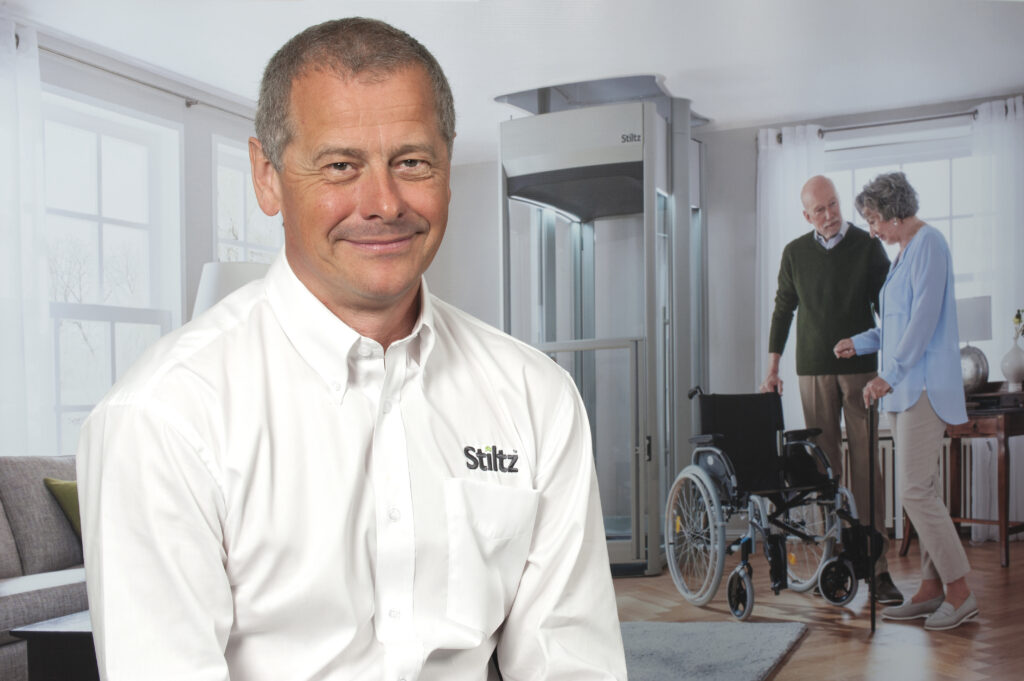
Research commissioned by Stiltz Homelifts in 2024 revealed that 70 per cent of adults over 50 want to stay in their current homes over the next decade, with half saying they have no intention of ever moving. However, nearly a quarter fear declining mobility will eventually force them to relocate. This mismatch between aspiration and reality highlights a growing crisis in housing design – one that not only limits independence but also risks placing greater strain on the NHS and social care systems.
By 2040, one in four people in the UK will be over 65. While most older adults wish to “age in place,” remaining in the homes and communities they love, the trend towards multi-storey, space-saving developments makes this increasingly difficult. Steep stairs, narrow hallways, and limited adaptability are becoming the norm – features that actively discourage healthy ageing.
The problem is not just physical accessibility but also the absence of foresight in planning. For decades, government housing policy has focused on numbers – homes built – rather than on quality and longevity. As David Sinclair, Chief Executive of the International Longevity Centre UK, warned in response to the 2024 Older People’s Housing Taskforce report, “It is not enough to build more houses for first-time buyers; we must also design age-friendly and inclusive homes that better suit people’s long lives.”
The Cost of Inaction
Unsuitable housing is a silent driver of poor health outcomes. Falls alone cost the NHS an estimated £2.3 billion annually, while cold, damp, and poorly designed homes exacerbate chronic illness and accelerate dependency. Every £1 spent on home adaptations – such as handrails, ramps, or walk-in showers – saves £1.62 in reduced health and care costs.
Beyond the economic calculus lies an emotional toll. Stiltz’s research found that 13 per cent of older adults believe being forced to move from their homes would negatively affect their mental health. For many, leaving familiar surroundings represents a loss of independence, identity, and community ties. Designing homes that evolve with their occupants is not only a practical solution but a moral imperative – one that supports mental well-being and social continuity.
The UK’s obsession with vertical expansion – three-storey townhouses and high-density developments – has created housing that is effectively “future-blind.” While it may satisfy short-term targets, it ignores the long-term realities of an ageing population.
Bungalows and single-storey properties, once considered essential for older people, have become rare and expensive. As a result, those with declining mobility often face an impossible choice: adapt their existing homes at great cost or move into residential care prematurely.
Stiltz’s research also shows that 23 per cent of adults over 50 already face mobility challenges, a figure that rises to 43 per cent among those over 70. If the built environment continues on its current trajectory, millions will find their homes uninhabitable long before their lives are over.
A Blueprint for Change
The government’s 2024 Older People’s Housing Taskforce and the British Property Federation have both issued clear calls for reform. They urge the creation of a national housing strategy for an ageing population, planning reform through a new “CR2” use class for senior housing, and the integration of older people’s needs into local plans. These are sensible measures – but they must be accompanied by practical, design-led solutions.
Accessible housing should not be viewed as a niche requirement but as a universal standard. The Housing Made for Everyone (HoME) coalition recommends that all new homes meet at least the M4(2) accessibility standard, ensuring basic adaptability for people of all ages and abilities. This is not a luxury – it’s a necessity. Currently, only nine per cent of UK homes meet these basic standards.
Designing for Real Life
True inclusivity in housing means thinking beyond ramps and grab rails. It means creating homes with level access at entrances, wide hallways, flexible kitchens and bathrooms, and crucially – vertical mobility options.
Domestic homelifts are an increasingly viable solution. Modern units are compact, energy-efficient, and easy to install in both new builds and retrofits. Yet public awareness remains low – just one in five homeowners knows how straightforward these installations can be. Integrating “lift-ready” frameworks at the design stage would allow homeowners to adapt seamlessly as their needs change, without the upheaval of moving or extensive renovation.
From Policy to Practice
To make this shift a reality, Stiltz recommends three key policy actions:
1. Update Building Regulations – Amend Part M to mandate “lift-ready” or “mobility-adaptable” designs as standard, ensuring homes can support lifetime living.
2. Incentivise Developers – Offer grants, tax relief, or planning advantages for inclusive design and early adoption of homelifts or adaptable layouts.
3. Lead a Cultural Shift – Launch public awareness campaigns and showcase exemplar developments that prove accessible homes are desirable, modern, and cost-effective.
These measures would align housing policy with health, social care, and equality objectives – turning inclusive housing from aspiration into expectation.
Homes That Last a Lifetime
If the UK is to meet the challenge of an ageing population, it must start by rethinking what makes a home “fit for purpose.” Inclusive, adaptable design is not a concession to ageing – it’s an investment in the nation’s future.
The construction industry, policymakers, and local authorities all have a role to play. By designing homes that people can live in for life, we can reduce hospital admissions, ease pressure on social care, and build stronger, more resilient communities.
The choice is clear – continue building upwards without looking ahead – or elevate housing design to meet the realities of how we live, age, and thrive.
The full white paper report is available to read here – www.stiltz.co.uk/blog/lifestyle/planning-homes-for-all-ages/
Leave a Reply