

By Mike Lord, CEO and Chairman of Stiltz Homelifts

For decades, the bungalow has been the gold standard of later-life housing. Single-storey living promises freedom from stairs, simpler maintenance, and the comfort of a private garden. For many older people, it has symbolised a sensible, even aspirational, step down from the family home.
But this long-standing assumption deserves urgent re-examination. As the UK faces a deepening housing shortage and a rapidly ageing population, our fixation on bungalows is not only impractical, it is actively holding back better, more sustainable solutions for older and less mobile people.
In 2022, around 12.7 million people in the UK were aged 65 or over. By 2072, that number is predicted to rise to 22.1 million, meaning our ageing population is not a short-term pressure but an issue that will shape housing, health, and public spending for decades.
Research by the HomeOwners Alliance shows that 38% of homeowners aged over 55 would like a bungalow for their next move – reflecting the demand, but not a viable solution.
Building more single-storey homes would barely scratch the surface of current need. Worse still, it risks diverting much-needed land, public money and policy attention away from approaches that could benefit millions more people.
Bungalows are inherently inefficient in terms of land use. A single-storey footprint requires significantly more space than a two-storey property of the same size. In a country where suitable development land is already critically short, this matters.
Every hectare used for low-density, single-level housing is a hectare that cannot deliver the volume of homes required to meet national targets. With the government committed to building 1.5 million new homes, we must build up, not out.
This is not just an abstract planning issue. Prioritising bungalows at scale would slow delivery, inflate costs, and ultimately reduce the number of homes available for people of all ages.
There is also a human cost to the bungalow ideal that is too often overlooked. Moving to a bungalow usually means moving away. These properties are rarely available in established streets where people may have lived for 30 or 40 years. Instead, they are often located on the edges of towns or in age-segregated developments.
For many older people, this means leaving behind neighbours, routines, and informal support networks. The result can be social isolation, loss of identity, and declining mental wellbeing. Research in our recent white paper – Planning Homes for All Ages, shows that 13% of people over 50 believe moving home would negatively affect their mental health. Forced relocation later in life has been linked to higher rates of depression and anxiety – outcomes that inevitably feed back into health and care services.
There is also a broader community impact. Older residents play an important part of society, from childcare support for working families to volunteering and civic participation. Removing them out of mixed-age neighbourhoods weakens communities at precisely the moment when it is most needed.
For similar reasons, I am sceptical of growing calls from housing-with-care operators, MPs and peers for a national policy to accelerate the development of housing specifically for older people. While specialist provision has an important role, it should not become the default.
Creating “older persons only” neighbourhoods risks institutionalising age segregation. A better approach is one where people of all ages can continue to live side by side, with homes that adapt as needs change over time. This is not only socially healthier, but also more flexible and more resilient in the face of demographic change.
The real solution lies not in mass relocation, but in enabling people to remain safely in the homes they already know. Most older people want this. Families want it, and from a public policy perspective, it makes overwhelming sense.
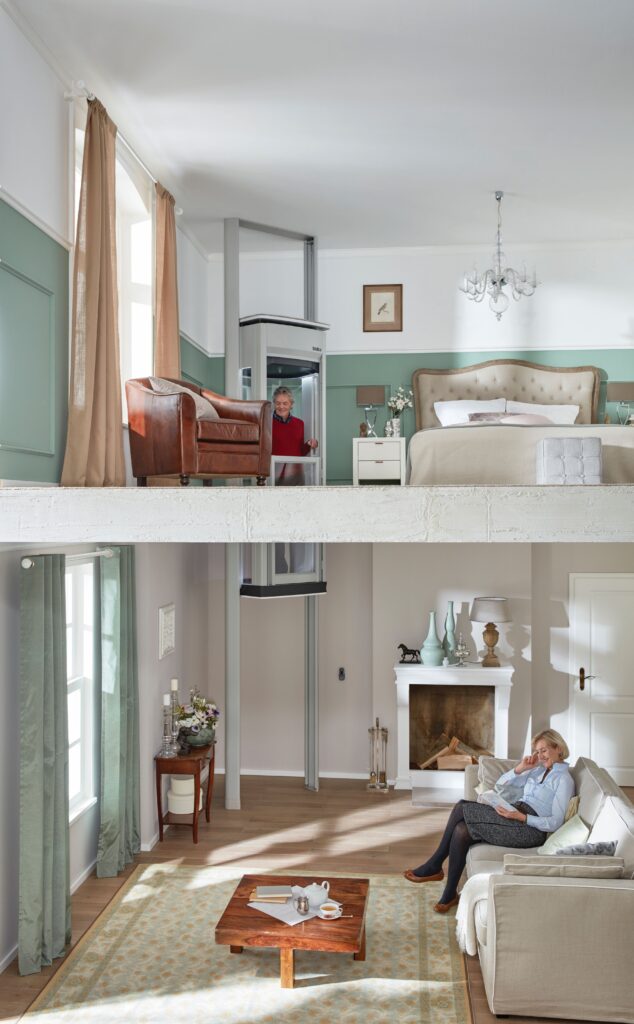
Simple, well-designed adaptations – handrails, level-access showers, wider doorways – can dramatically reduce the risk of falls and loss of independence. More transformative measures, such as compact domestic lifts, remove the staircase as a barrier altogether, allowing multi-storey homes to function as effectively as single-storey ones.
The economic case is compelling, for every £1 invested in preventative housing adaptations, the NHS and other care agencies save an estimated £1.62. Fewer falls mean fewer ambulance callouts, fewer hospital admissions, and shorter stays, easing pressure on an already stretched National Health Service.
This is why the focus of housing policy must shift decisively towards adaptability. The homes we build today will still be standing in 50 or 100 years. Designing them around the needs of the fully non-disabled first-time buyer alone is short-sighted.
All new homes should be built to support ageing in place from the outset. That means level entrances, wide hallways suitable for wheelchairs, and structural provision for the future installation of lifts. These hese features do not detract from a home’s appeal to younger buyers, they future-proof it.
Local councils have a critical role to play here. Building regulations already allow adaptable, accessible standards, but adoption is inconsistent, and enforcement is uneven. Clear national leadership is needed to ensure that vertical mobility is treated as a core design consideration rather than an optional extra.

Developers, too, must be part of the solution. Incentives, whether through planning flexibility, tax measures or accelerated approvals, could encourage the construction of accessible, multi-storey homes that work for people at every stage of life.
The shortage of suitable housing options is already driving some older people into residential care earlier than necessary, often funded through debt or the forced sale of assets. According to the UK Seniors Housing Report 2024, there will be a shortfall of 46,000 retirement and seniors housing over the next five years. Simply building more bungalows will not close that gap.
The UK’s love for bungalows is understandable, but nostalgia is a poor guide for policy. If we are serious about addressing the housing crisis for older and less mobile people, we must move beyond the idea that single-storey living is the only answer.
By investing in adaptable homes, supporting ageing in place, and designing new housing with vertical mobility in mind, we can create communities that are inclusive, efficient and fit for the future. The choice is not between independence and density, or between well-being and growth. With the right approach, we can, and must, deliver all three.
White Paper, Planning Homes for All Ages is here: www.stiltz.co.uk/blog/lifestyle/planning-homes-for-all-ages/




Recent Comments