

Why do so many UK government projects fail and what can be done about it?
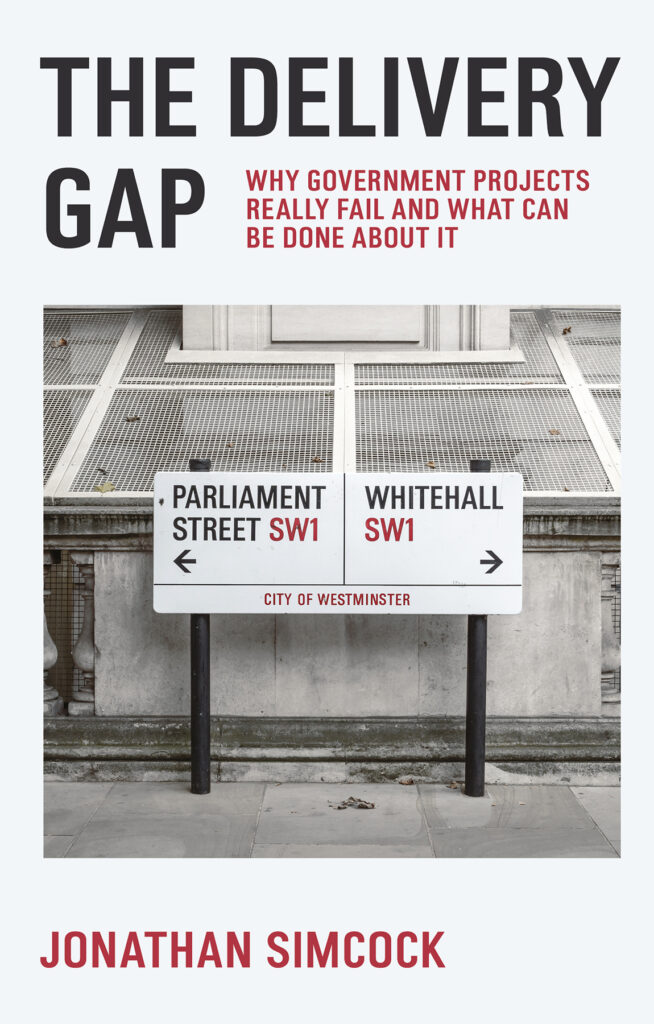
A new book, The Delivery Gap: Why Government Projects Really Fail and What Can Be Done About It by Jonathan Simcock (Emerald Books), looks behind the scenes to uncover the problems that plague government projects and offer fresh solutions.
Jonathan Simcock, former Major Projects Director of the Office of Government Commerce, analyses seven well-known projects – with combined costs greater than the annual UK expenditure on education, policing, prisons, housing and overseas aid put together. As well as HS2, these include Crossrail, the NHS National Programme, Universal Credit and the restoration and renewal of the Palace of Westminster.
Some of what government achieves is accomplished through policy. A tweak to taxation, reform of the curriculum, funding more policemen. But sometimes government has to actually build or buy something. A road, a hospital, a school, a defence system. And sometimes it has to do something big. Really big. A fleet of nuclear submarines, a completely secure data infrastructure linking every home in the country with every energy company, the first new underground railway across London for 40 years, an IT system big enough for the health records of every person in the country.
The private sector plays its part, but only government can lead projects on this scale. The problem is that if you compare what these mega-projects actually deliver with what was originally intended, successive UK Governments have a really miserable record. Almost universally, very big projects are either late, over budget, deliver less than promised – or all three. Some, like HS2, are never completed at all. And it really matters.
The UK is emerging from political turbulence and the Covid pandemic deep in debt, with stagnant growth, poor productivity, and taxation levels at historic highs. We do not have tens of billions of pounds to waste on half a high-speed railway. Our degraded public services need reform now, not after years lost to failed IT projects. The world has become a more dangerous place; national security requires new capabilities to arrive on time. And the climate challenge can’t be met without unprecedented transformation in the nation’s energy systems.
From outside the opaque world of public sector project delivery, commentators struggle to understand why our performance is so poor. How hard can it be? Surely you just decide what to do, work out how long it will take and how much it will cost, then procure somebody to deliver it. Not everything will be easy, to be sure, but surely we should be successful far more often than we are.
In the wake of the cancellation of HS2, Jonathan Simcock set out to understand what is causing this malaise. He spoke to the insiders – ex-ministers, advisors, civil servants and project managers – who have tried, and mostly failed, to deliver some of the largest and most complex projects of the last two decades. Through their stories, he began to understand the structures and incentives that are at the root of failure and concluded that no amount of improved process, enhanced capability, or sharpened accountabilities will solve the problem, unless the destructive underlying tendencies described in this book are exposed and addressed.
Of course, some public sector projects are successful and some other countries struggle with the same issues but we can and must do better. If we are to overcome the huge challenges we
face as a country – poor productivity, high debt, low growth, rising security threats and a changing climate, we must change the way we think about mega-projects. We have to close the delivery gap.
“This compelling book lays bare the systemic problems that have plagued major government projects for too long.” – Francis Maude (Lord Maude of Horsham), Former Cabinet Office Minister
“Essential reading for anyone involved with the planning or execution of large projects.”
– Mark Wild, CEO of HS2 Ltd, former CEO of Crossrail Ltd
This is an edited extract from The Delivery Gap: Why Government Projects Really Fail and What Can Be Done About It (Emerald Publishing, £19.99).



Recent Comments