|
|
 Rada’s expertise in delivering robust and sustainable commercial showering and digital washroom controls has been demonstrated through a project at the Ministry of Defence’s Dale Barracks site in Chester. Rada’s expertise in delivering robust and sustainable commercial showering and digital washroom controls has been demonstrated through a project at the Ministry of Defence’s Dale Barracks site in Chester.
Refurbishment works across multiple blocks of the purpose built infantry barracks saw Rada supply a range of products including its T1 100 timed flow taps, VR2 CC high performance chrome-plated shower fittings with concealed pipework, and the revolutionary Rada Outlook digital mixing valve and washroom control system.
Rada Outlook, launched into the marketplace in 2012, provides precise temperature and flow duration across any configuration of six showers or washbasin spouts, with touch or non-touch sensor options and is suited to both refurbishment and new build projects.
For multiple washrooms, up to 31 Outlook units can be connected to form a building–wide digitally controlled washroom water management solution using an IT Network or Building Management System, and with innovative functions including automatic duty flushing and supervised thermal disinfection settings, it can deliver significant manual resource and cost savings.
Penny Veale, Head of Media Operations for the Army (North and East regions), said: “The new washrooms form part of a large scale refurbishment programme currently being undertaken at Dale Barracks. Such a project requires high quality, safe and durable fixtures and fittings which will stand the test of time as well as complying with all legislative requirements. By working in conjunction with specialists such as Rada it ensures we achieve our refurbishment objectives in line with exact legislative, time and financial perameters”.
The Rada team worked closely with the MOD and Carillion Facilities Management on the project, providing site surveys and specification assistance.
Eoin McQuone, Senior Marketing Manager at Rada, explained: “Our early stage involvement in the Dale Barracks project enabled us to add value via a combination of expertly engineered mechanical and digital washroom solutions. All of the products specified, together with their associated sensors, were selected for their ability to meet the robust needs of a military environment, with user safety and whole life cost savings in mind. We are delighted to work with the MOD and Carillion Facilities Management and hope to work with them again in the future.”
Rada has been designing and developing commercial showering, washroom controls, fittings and systems for UK and overseas markets for over 80 years.
Outlook, one of its most recent innovations, has been designed to meet the demands of a wide range of environments including commercial washrooms, education, multi-residential and sports and leisure. It incorporates the Rada T-LogicTM digital intelligence for efficient communication between components for ultimate safety and hygiene control.
In fact, Rada has been leading the way in developing washroom technology since introducing the very first thermostatic mixing valve into the UK back in the early 1930s. It has achieved a number of ‘firsts’ including introducing the UK’s first thermostatic tap – Thermotap in 1996, and the world’s first digital re-circulating water temperature control valve, the DRV80, in 2008, which was designed specifically to be the primary water temperature controller in a continuously pumped circulating hot water system in a commercial building.
All Rada products offer end users the very highest standards in safety, water and energy savings, reliability, precision and control.
Rada is part of the Kohler Co. family of companies, which includes Mira showers, and is located in Cheltenham, UK. For more information on Rada’s digital washroom expertise please visit www.radacontrols.com
By David E P Dennis FCIPD LCGI RAF – Arachnoid Articles
On clear nights it is easy to see Mars, reddish and distant. The planet is around half the size of Earth and the pull of gravity is far less than on our planet. Astronauts travelling to Mars would be weightlessly suspended in what is called ‘microgravity’. With the latest US unmanned spacecraft ‘Curiosity’ on the surface and its discovery of substantial water within Martian soil, there has been pressure on NASA to consider a manned expedition to Mars. A separate private investor-funded project called ‘Stichting Mars One’ is encouraging people to volunteer for a seven-month one-way trip as ‘colonists’. Four colonists would go in 2023. Many others would follow.
What are the problems of such a journey? Can humans really survive a trip to the Red Planet and get back to Earth? What about radiation – or micrometeorites puncturing the hull of the ‘ship’? How many people should go to set up a viable permanent colony? These are typical questions from children and adults alike. But there is one deeply relevant question that most people never ask: ‘What happens to the cerebrospinal fluid surrounding your brain and spine on a Mars trip?’
This question and its response are absolutely critical to the human exploration of Mars and as Chair of the national medical charity IIH UK (www.iih.org.uk) I am deeply involved in thinking about the problems experienced by US astronauts who have suffered medical setbacks in space. IIH UK is a member of the NASA Human Health Programme. We have corresponded with NASA and with the University of Ohio scientists who have been working with NASA. I have made a formal proposal to NASA and JPL Pasadena for an experiment to be placed on the next NASA spacecraft in 2020.
It makes sense to highlight the central problem of naivety for any member of the public who thinks that they can go to Mars without facing the very greatest difficulty or even death. On the 13th September 2013 the BBC ran a headline:
US man volunteers for one way flight to Mars
The article said: ‘It is the trip of a lifetime – for a lifetime. US man Aaron Hamm has volunteered to fly one-way to Mars, despite no prospect of ever returning to earth. The trip is run by the Dutch Mars One project, which hopes to create a permanent community of settlers on the red planet in 2023. Radiation exposure is a concern, and travellers could never readjust to the Earth’s gravity afterwards. But Mr Hamm is determined to take the flight. He told BBC Radio 5 Live’s Breakfast: “Wanting to go somewhere genuinely new… and be a part of something that’s really about humanity’s future is something I’ve always wanted to do.”
Also in September 2013 the BBC stated that 850 Irish people wanted to go one-way to Mars:
‘The Irish applicants are among 202,586 people from around the world who have expressed their interest in taking part in the Mars One project.’
Plainly a great many people are interested in going to Mars and staying there. But some US astronauts have had a dreadful time just living in microgravity on the International Space Station (ISS). At the four month point and thereafter, at first seven astronauts and then 27 astronauts experienced vision problems, severe headaches, memory loss and general operational competence problems due to an effect called ‘celephad shift’.
Each human and most animals that can stand or rear upright have membranes around their brain and spine which hold a clear liquid called cerebrospinal fluid (CSF). On Earth this circulates and refreshes every five to seven hours. The CSF is made in the brain and cleans it, taking unwanted products back to the blood via various routes. In microgravity the CSF rises upwards and pools in the head causing an overpressure in a bony skull with fixed capacity. The pain and discomfort and severe vision problems (papilloedema) are similar to that suffered by IIH patients on Earth – IIH being Idiopathic Intracranial Hypertension.
So going to Mars will depend on a great number of as yet unassessed aspects. Let us take some of them. In 1971 and 1975 two science papers were published which showed that not all humans are born with all the means to transfer CSF to the blood. In the first instance two children who died were found to have no ‘villi’ or ‘granulations’ – the tiny organs that allow the CSF to revert to the blood. These are normally located inside the skull at the top of the head in an area called the supersaggital ridge. By the time you are 4 years old you will have around 50 ‘granulations’. In 1975 it was reported that of 14 individuals with CSF pressure problems, 11 had no granulations.
It is thought the granulations are formed by genetic instructions from stem cells. If the stem cell instruction is imperfectly enacted a person may not have all the ‘villi’ or ‘granulations’ required to pass the CSF back to the blood at the same rate as it is formed, thus causing an overpressure. Of those with IIH, 25% of men go blind and 12.5% of women also lose their sight.
The normal rate of incidence of IIH in humans is 1 or 2 in 100,000 and for obese women of child-bearing age it is around 20 in 100,000. So, for male and female non-obese non child-bearing age colonists numbering a potential 200,000 or more we might expect four to get IIH. With women colonists of child-bearing age we might expect a few more with problems.
But that is not what actually happens. Celephad shift is not IIH. It is a physical movement of fluid upwards for everyone who is weightless. There is only a small pool of US astronauts numbered in the hundreds and yet 27 of them have already had a dreadful time. Let us say that some 300 astronauts have worked on the ISS and 27 of them have become ill. That is a rate of 11%.
Now apply 11% to 200,000 and you can see that we are in trouble with our Mars colonisation. If they all go over time, then twenty-two thousand colonists could become ill with celephad shift problems. Some could be captains, navigators, engineers who want to ‘boldly go’.
What can we do? This article is not long enough to cover all the routes that CSF takes back to the blood, but IIH UK is already designing research into the monitoring of the number of human granulations that most people have and ensuring that with IIH there will be a way of telling people if they have enough effective granulations. This check needs to be done for all astronauts. If a colonist’s granulations have not grown sufficiently or if they are blocked by old brain products and salts, then these people are ‘high risk’ and should not go to Mars.
 The IIH UK position is that while we fully support NASA and human exploration of Mars, we think it is being ‘rushed’ and that unnecessary pressure is being placed on members of the space programme to ‘boldly go’ when they really should be waiting until celephad shift problems are controllable. The IIH UK position is that while we fully support NASA and human exploration of Mars, we think it is being ‘rushed’ and that unnecessary pressure is being placed on members of the space programme to ‘boldly go’ when they really should be waiting until celephad shift problems are controllable.
IIH UK has proposed in writing to the NASA Chief scientist that all long distance spacecraft should be rotated to induce artificial gravity – or the sleeping/resting couches of the crew should be rotated to enable the CSF to move back towards the feet. NASA astronauts will stay on Mars and come back again so their weightless or partial weightless time will be some 17 or 18 months.
The next major problem for the colonists is that Mars is smaller so gravitation is far less. So when they live permanently on the surface of Mars there will still be a constant celephad shift of CSF towards the head, and unless their sleeping couches are rotated to move the fluid back down the body, many of them will have dreadful headaches and severe sight problems for the rest of their lives on Mars.
Mars is not going to go away – let’s not rush towards it.
If you would like to discuss this or know more about the problems please email Arachnoid Articles at david@arachnoid.org.uk
I cannot promise to answer every email instantly but I will do my best!
 Protecting confidential business relationships used to be easy. You just kept your mouth shut. Protecting confidential business relationships used to be easy. You just kept your mouth shut.
But the internet makes it easy to disclose people’s details, without even realising it. And that could have serious professional consequences.
This checklist will help to keep you out of trouble:
- Tell your contacts not to pass on personal messages on public social media pages. This might be obvious to you – but what if they don’t know the difference between a direct message and a public one?
- Make sure you don’t copy an email to someone else by mistake, or insert the wrong name in the name field using auto-insert.
- Just being connected to someone on LinkedIn or a similar platform acknowledges that you have a connection with them. Do they want their colleagues and employer to know that? In some professions, the link could breach client confidentiality.
- Beware Tweeting that you’re meeting someone. They might not want anyone else to know. And make sure the location is disabled on your cell phone and tablet.
- Double check your privacy settings on any work-related social media site, in case you end up communicating information to your friends and friends of friends, by mistake. Restrict who is able to access your information, and review it, frequently.
- Remember that the default privacy settings for both Twitter and Facebook allow some information to be shared with everyone, unless you change them.
- Keep separate social media accounts for work and personal life and refuse to engage with contacts on your personal feed … otherwise you could say things to them that could be seen by others.
- Do not to criticise your contacts or sound off about work on your personal social media pages. Employers are not legally obliged to disregard an employee’s conduct simply because it occurs outside the work place.
- Don’t criticise anybody in an email or on the web. Assume it will be passed on. If it is, it could be anything from embarrassing to defamatory.
- Remember: anything you write on a social media site can be used against you, in a court case.
Cleland Thom is a consultant and trainer in internet law, media law, reputation management, and web writing.
His clients include FT 100 businesses and renowned UK media, government, educational and non-profit organisations.
He is a member of the Society of Editors, and serve on the Chartered Institute of Journalists’ Professional Practices Committee.
By Cleland Thom
www.ctjt.biz
 This one-day national conference is focussed on helping Safeguarding Officers, Social Workers, Teachers, Care Workers, NHS and voluntary sector staff to become more effective in their vital roles in safeguarding children and protecting vulnerable adults. This one-day national conference is focussed on helping Safeguarding Officers, Social Workers, Teachers, Care Workers, NHS and voluntary sector staff to become more effective in their vital roles in safeguarding children and protecting vulnerable adults.
National Safeguarding Conference – 23rd October 2013 – Coventry
Please see the link for further details www.national-training.com/safeguarding
A new lockable cleaning trolley system designed for high-risk healthcare environments is already proving its worth at a hospital in a major NHS trust. 
The new system and equipment, supplied through Jigsaw Cleaning Systems, is being used on Magnolia Ward in Yeovil, part of the Somerset Partnership NHS Foundation Trust.
The trolleys are made from high-impact strength plastic, which offers lockable compartments and are designed to enhance storage efficiency.
David Dodd, Facilities manager for the Trust, said: “The trolleys have been purchased to help the service assistants deliver an efficient and very importantly a safe service ensuring that the cleaning chemicals used are safely locked away to prevent any patient inadvertently having an accident with them.”
The compartments of the trolley – manufactured in Italy by the product specialist Filmop – can accommodate various kinds of cleaning products and are colour coded to reflect different materials and fluids.
Brian Boll, systems director at Jigsaw Cleaning Systems, said: “The methods and equipment for cleaning in modern healthcare settings are changing and the lockable trolley offers huge benefits in a high-risk environment whilst offering efficiencies all round.”
 Brian Boll The Somerset Partnership NHS Foundation Trust provides a wide range of integrated community health, mental health, learning disability and social care services to people of all ages.
The Department of Health has recently released figures which show that NHS spending on cleaning last year was up £40.7m to £937.9m.
A new specification on cleaning in hospitals was published last year by the Department of Health, National Patient Safety Agency and the British Standards Institution.
New anti-bacterial trolley system is a first
A major breakthrough in the battle against bacteria has been made with the launch of the first anti-bacterial cleaning trolley system to the UK market.
The A-B Plus Anti-Bacterial System, launched by Jigsaw Cleaning Systems and developed by Filmop, offers a total solution to infection control in cleaning and is also resistant to chlorine, often a damaging agent in healthcare environments.
The count of bacteria – the source of infections such as Norovirus, E-coli and Salmonella – goes consistently down when it comes into contact with the trolley system.
Using this system means the cleaning of hospitals and other healthcare premises is hygienic and bacteria-free and is particularly relevant for high-risk areas such as operating theatres, infection disease wards and intensive care units.
Institutions such as nursing homes, schools and universities, and areas in airports, shopping malls and large public spaces can all be cleaned with the same bacteria-free benefits.
James Blackhurst, managing director of Jigsaw Cleaning Systems, said: “This system offers an anti-bacterial system in the trolley and all its parts even down to the tyres and the screws.
“We’re hugely excited about it and, working with Filmop, we think we can offer a new solution to this issue which has presented so many problems to healthcare and other institutions.
“The cleaning equipment and materials used through this process are a key element in keeping out bacteria and we believe this can make a real difference.”
Contact Brian Boll on 01772734932 or e-mail brian.boll@jigsawcleaningsystems.co.uk for support or see www.cleanleanhealthcare.org
 UK infrastructure is a paradox. We have world-renowned capabilities in architecture, engineering and construction. Yet, with some exceptions, like the Olympics and Crossrail, our record at creating business, service and communications infrastructure is a best indifferent. There is chronic underinvestment. We need to spend around £500bn to bring the UK’s transport, energy and telecoms networks up to the standards of Europe’s best. Too many projects get cancelled, delayed, or stuck in the planning system. This creates investor uncertainty and high costs. Short-termism and the political cycle threaten major initiatives that by their nature require decades to plan and deliver. UK infrastructure is a paradox. We have world-renowned capabilities in architecture, engineering and construction. Yet, with some exceptions, like the Olympics and Crossrail, our record at creating business, service and communications infrastructure is a best indifferent. There is chronic underinvestment. We need to spend around £500bn to bring the UK’s transport, energy and telecoms networks up to the standards of Europe’s best. Too many projects get cancelled, delayed, or stuck in the planning system. This creates investor uncertainty and high costs. Short-termism and the political cycle threaten major initiatives that by their nature require decades to plan and deliver.
The Coalition seems determined to address this. Ministers tasked Infrastructure UK, the Treasury body that advises on these matters, to produce the first National Infrastructure Plan. The Treasury is working to attract private infrastructure investment, introducing new guarantees to underwrite investors’ risks, recasting public private partnerships, and trying to get pension fund finance into the system. Lord Deighton has been appointed Commercial Secretary to the Treasury, in effect our first Minister for Infrastructure. And in this year’s Spending Review, Chief Secretary to the Treasury Danny Alexander announced a £100bn infrastructure programme, including the biggest expansion of road building in generations.
All very welcome. Small steps in the right direction. Yet only small ones. Fiscal constraints mean private investors will have to shoulder the bulk of the investment load. Yet they’re still not coming forward in the necessary numbers. Despite recent advances, including permission for Hinckley Point C Nuclear Generator, the long-term resilience of our energy infrastructure remains questionable. And continuing controversies around HS2 and airport capacity illustrate the absence of a political consensus and the poverty of our national debates.
So the Management Consultancies Association is calling on government to go further, faster in our report Building Blocks: How Britain Can Get Infrastructure Right.
UK infrastructure needs better planning. Infrastructure is not an end in itself. It is an enabler of growth. Government should define what infrastructure is for first, then determine what projects to back. It should focus on projects likely to reap the greatest benefits, using experts to investigate and determine those benefits. This approach would bring clear principles to otherwise contentious matters like the future of UK airports. It would help government produce better infrastructure business cases. Currently, government struggles to win public support for major projects, like HS2. That’s because it doesn’t focus early and clearly enough on outcomes: what infrastructure changes for the better in the real world. To help government choose the right projects and forge cross-party a new independent Office for Infrastructure should be established.
Our infrastructure needs secure approaches to funding. The Treasury Guarantees Scheme should be extended. Government should also make clear what the funding model is for each project in the National Infrastructure Plan. This will give investors clarity and certainty. Investors need to know how long-term service revenues from assets will be generated. If those revenues depend on public spending, government should make clear what it will fund – and what it will not. Crossrail has succeeded in part because of this sort of clarity. Infrastructure experts can also help government get more pension funding into infrastructure by advising funds, who may be new to this terrain, on how to target their investments.
Above all, the UK needs better approaches to infrastructure delivery. To help reduce tensions and delays in the planning system, communities affected by infrastructure projects should get a greater share of the benefits, such as a bigger slice of increased business rate income new projects can bring. There should be specific and appropriately resourced delivery structures for major projects. The Olympics shows the benefits of these sorts of structures, where experts with proven track records are specifically recruited and rewarded to deliver projects. Experts should also devise and commission projects, to avoid errors in project design that are expensive to eradicate.
Implementing the 21 recommendations in our report would take the UK a long way towards infrastructure excellence. Yet the report also showcases successes the UK can build on. We may not build enough high-quality assets. But as the Olympics, Crossrail and a host of less glamorous initiatives show, we have the capability to do so. The UK’s world-class infrastructure advisers are already helping to marshal project finance, develop business cases and manage complex programmes, both here and across the globe. They pull together the very dispersed and complex value-chains required to deliver infrastructure projects. Already a major export, they should be at the heart of efforts to make the UK a centre of infrastructure expertise and excellence. Currently these experts are often used late in the day to get failing projects back on track. Getting them in early to help choose and plan the right projects is a better – and cheaper – way to employ them.
Paul Connolly is Director of the MCA Think Tank. Building Blocks can be found at the MCA Website, www.mca.org.uk
 Cllr Colin Lambert, Leader of Rochdale Borough Council said: “A fair day’s work for a fair day’s pay will be guaranteed for all staff at Rochdale Council”. Cllr Colin Lambert, Leader of Rochdale Borough Council said: “A fair day’s work for a fair day’s pay will be guaranteed for all staff at Rochdale Council”.
In line with his vision to promote a fairer and more equal society for the people of Rochdale, the minimum pay rate for council workers will now be set at £7.26 per hour. The rate increase for the council’s lowest paid workers will take effect subject to formal ratification at full council on 30 October and will be backdated to 1 September.
The National Living Wage Scheme has been adopted by hundreds of employers nationally across every sector. According to London Mayor Boris Johnson “It is an investment which makes sound business sense.” Paying staff a living wage has broad benefits throughout society. It means more money is distributed throughout the local and greater economy. Staff are more committed to their work and there are lower sickness levels.
Cllr Lambert added: “We are proud to be able to ensure that our employees have the opportunity to provide a better standard of living for themselves and their families. We will be encouraging our partners and the broader business community to do the same.”
The National Living Wage Foundation was formed by a group of low paid workers who were working long hours doing two jobs and still could not make ends meet. According to their findings: 80% of employers believe that the Living Wage had enhanced the quality of the work of their staff. They have had improved loyalty and customer service and fewer complaints. Adopting a Living Wage can cut absenteeism by 25%.
National Living Wage Week is 4-10 October. For further information you can go to www.livingwage.org.uk
 Stoke road safety 2013 Education plays an important part in everyone’s lives, especially in the early years as young people move into the workplace. Key to this success is staying safe. However, it is a sad fact that road traffic incidents claim countless lives every year.
Road safety is an essential ‘life skill’, traditionally delivered to children throughout their school years by dedicated Local Authority road safety teams, often working in partnership with the Police and Fire Services.
Due to Government cutbacks in public spending, road safety around the UK has taken a significant hit with some services being scaled back or stopped completely. There is however a viable alternative uniquely offered by TTC Road Safety Services (TTC RSS), part of the successful TTC Group of companies.
Experts in the field of road safety
TTC RSS is managed by experts in the field of road safety education who come from a long career in Local Authority road safety. This assures a consistent and thorough approach to road safety delivery within all sectors of our communities.
Road Safety for schools and colleges
Whether a primary school, high school or college, TTC RSS have a programme for most year groups. In the early years training focuses on pedestrian training skills while before going to high school the emphasis shifts to looking at safe and independent travel. As pupils progress towards driving age, the focus is on developing those essential skills that are necessary to become a safe driver.
Supporting Local Authorities
Local Authorities have gone through some challenging times of late and it is likely that more will follow. TTC RSS are able to support Local Authority road safety teams in a number of ways, for example:
- Provision of road safety trainers to complement existing teams during periods of high demand
- Individual road safety schemes, managed and delivered by a TTC RSS professional trainer
- Provision of a managed road safety service, bespoked to individual requirements
- Provision of a secure web based road safety management system that will reduce the admin required to manage road safety schemes, such as pedestrian training, cyclists training or a minibus permit scheme
Support for independent schools
Schools that have opted for independent status can now access a comprehensive and personalised road safety service. This can be from a one-off intervention to a suite of initiatives spanning the entire year groups.
Support for businesses
A significant number of collisions occur while drivers are on a work related journey so businesses should manage these risks via a robust policy and instill a ‘road safety’ culture within their company. TTC RSS are able to support businesses in the following way:
- Development of a road safety policy
- Provision of in-class or on-road driver development (all vehicle categories)
Minibus driver coaching scheme (with optional permit)
Many organisations operate minibuses primarily driven by well-meaning and enthusiastic volunteer drivers. It is likely that unlike coach drivers, minibus drivers will not have undergone any formal training. A minibus driver coaching scheme, particularly if it is linked to a permit, can be a wise investment as it ensures the best possible steps have been taken to minimise the risks. TTC RSS’s operate a minibus scheme that is flexible and can accommodate anything from a single driver to the large fleet. For those with specific scheme requirements, TTC RSS can accommodate these into a personalised programme with an on-line booking and scheme management system.
Case study 1
City of Stoke on Trent Council was faced with the challenge of delivering pedestrian training to 3,000 primary schoolchildren within a three month period. Due to a severe lack of staffing resources this appeared to be an impossible task until they engaged the services of TTC RSS who:
- Contacted targeted primary schools
- Scheduled pedestrian training sessions (managing all school and trainer bookings)
- Recruited, trained and monitored local road safety trailers (all came from a teaching or road safety background)
- Delivered pedestrian training to 3,000 children, on time and within budget
Wirral Council contracted TTC RSS to deliver the practical driver assessment and coaching element of their minibus scheme. As well as recruiting, training and monitoring local minibus assessors, they provided the road safety team with a web-based programme management system that has streamlined their administrative processes and provided a 24/7 on-line booking service for participants of the scheme.
Case study 3
Warwickshire County Council wanted to run some cyclists training to encourage cycling to work. TTC RSS wrote an innovative in-class and on-road course, managed the bookings and course delivery, providing a seamless service for the council and their client.
We’d love to hear from you
If you would like to invest in any element of road safety, from a single scheme to a fully managed service, or you are a business wanting to develop a road safety culture, you can contact us in a number of ways:
01952 607 187
contactus@ttc-uk.com
www.ttcrss-uk.com
Adrian Hide, Director TTC Road Safety Services
 From the consumer’s end, CTA (Council Tax Advisors) come as a godsend to the millions of individuals and businesses that owe Council Tax arrears. Offering free telephone advice and helping clients communicate with their Local Council to set up manageable repayment plans, thousands have turned to CTA after bailiffs have come knocking. From the consumer’s end, CTA (Council Tax Advisors) come as a godsend to the millions of individuals and businesses that owe Council Tax arrears. Offering free telephone advice and helping clients communicate with their Local Council to set up manageable repayment plans, thousands have turned to CTA after bailiffs have come knocking.
However, in a bold new move, the company has announced that it is now offering its services to Local Councils themselves, in the hope of halving bailiff use by 2016.
The free service will be offered to Councils across the country as an alternative to traditional bailiff enforcement. By not charging any fees at all, CTA’s services are expected to come as a direct benefit to Local Authorities and other debtors.
“Millions of homeowners are in arrears and dozens of businesses each week are forced to shut their doors due to unpaid Council Tax bills. Bailiff action really isn’t the best option and each of our services is designed around avoiding bailiff intervention,” says Chris Richards, Founder of Council Tax Advisors.
Continuing, “We help anyone with our free advice and our paid mediation services usually come in at less than £150. By dealing with major bailiff companies including Equita, Ross & Roberts, Rossendales, we’ve been able to stop their action and negotiate sensible repayment plans on behalf of clients. We’re now turning things on their head and offering to work free of charge with the Local Councils, directly.”
The relationship will be the first of its kind in the United Kingdom, expected to bring relief to many whose lives have been put on temporary hold while potential action is discussed or as it physically takes place.
“Nobody needs a bailiff at their door and their drastic action starts long before they arrive. The threat of bailiffs brings many people stress, worry and directly impacts all areas of their lives. We’re trying to prove that a softer and more calculated reaction can ultimately be more amicable for both sides. Local Councils will save money on resources and, using our expertise, we’ll ensure repayment plans are put in place for them to get the taxes they deserve,” says Richards.
CTA currently has a 98% success rate at stopping bailiff action, with 60% of problems resolved during a single free phone call with the client. Through the company’s new partnerships, these high success rates are set to bring a drastic reduction in the number of bailiffs being put to work.
All interested Local Authority parties are urged to make contact today to set up an initial consultation, free of charge.
For more information, visit: www.counciltaxadvisors.co.uk.
The company can also be reached via telephone: 01225 667 667.
 NHS Wales, the publicly-funded healthcare body tasked with providing care services for three million citizens of Wales, is expanding its use of Ipswitch FT’s MOVEit Managed File Transfer system to 5,000 third party public service users, including health boards, social service providers, ambulance operators and the police. NHS Wales, the publicly-funded healthcare body tasked with providing care services for three million citizens of Wales, is expanding its use of Ipswitch FT’s MOVEit Managed File Transfer system to 5,000 third party public service users, including health boards, social service providers, ambulance operators and the police.
NHS Wales is the over-arching body responsible for all health boards and trusts within Wales, encompassing 65,000 staff nationwide, working across hospitals, university hospitals, GP surgeries, clinics, dental practices, palliative care, pharmacies and more. Its challenge was to rationalise and secure information flow, guard against the regulatory censure of already-cash-strapped agencies, and robustly fulfil its duty of care for patient records.
One of the major drivers for adopting a secure managed file transfer solution was data protection requirements laid out by the Information Commissioner’s Office (ICO). The ICO is the UK’s independent authority set up to uphold information rights in the public interest, promote openness by public bodies and safeguard data privacy for individuals. By using Ipswitch File Transfer’s MOVEit technology, NHS Wales also meets ISO 27001 security standards.
Ipswitch FT MOVEit was initially procured solely for use by the staff of infrastructure support and operational teams within NHS Wales Informatics but it soon became clear that it was the ideal solution for the whole of NHS Wales. Currently, NHS Wales has a MOVEit user-base of around 2,000 third party users, including social services, ambulance operators and the police. By the end of the summer this installed base is expected to rise to 5,000 users, as awareness and demand for MOVEit grows. NHS Wales is also testing the Ad-Hoc facility within MOVEit for sharing files and data securely through Microsoft Outlook.
Prior to implementing Ipswitch File Transfer, NHS Wales employees had trouble sharing information securely between sites around the UK particularly when large file sizes, or sensitive information were involved. This saw staff resort to posting paper-copies of records, or couriering discs of MRI scans and x-rays. Today employees depend on MOVEit to ensure secure managed transfer of confidential information from health boards to other health boards, and to social services, clinical trial sites, solicitors, police, health inspectorates and external commercial third-parties.
Through Ipswitch FT technology, IT representatives within NHS Wales are equipped with the knowledge of how, when, where and with who sensitive information, such as patient records and x-ray files, is being shared. IT teams are now able to properly track, manage and encrypt mail traffic while at rest or in transit, and take protective precautionary measures when necessary. Such visibility allows for reporting to upper management in a timely, highly-effective manner, creating a confident work environment within the internal IT department.
Ipswitch File Transfer partner, HANDD Business Solutions, provided NHS Wales with implementation and consultation services when rolling out Ipswitch File Transfer MOVEit. HANDD Business Solutions continues to provide NHS Wales with continuous technical support on an as-needed basis.
Andrew Glencross, senior IT security specialist at NHS Wales Informatics Service, is responsible for providing the operational security wrap for all national applications and infrastructure covering every site across NHS Wales. He explained: “As soon as we (NWIS) started using IpswitchFT MOVEit, more and more agencies began asking us if they could take advantage of the service too. We then began rolling it out to other health boards and trusts so that they could also share information securely with their third-parties, such as police crews, ambulance operators, social services, and others – and we simply haven’t stopped! Ipswitch File Transfer’s technology partnered with HANDD Business Solutions’ responsive consultation services has given us a high level of confidence in the security of our data transfers that we didn’t have in the past, helping harness our trusted reputation and meet regulatory compliance across the board.”
Rich Kennelly, president of Ipswitch’s File Transfer division, said: “Safeguarding healthcare data is of critical importance, with staff across multiple agencies and sites constantly needing to share everything from clinical scans to patient records with internal and external parties, quickly and securely. MOVEit powers many segments of the healthcare industry, including healthcare providers, healthcare services and pharmaceutical companies. We are delighted that NHS Wales trusts Ipswitch’s Managed File Transfer solutions to reliably and securely transfer sensitive information and provide the visibility and control and auditing capabilities demanded by the ICO and other regulatory bodies.”
About Ipswitch File Transfer
Ipswitch File Transfer provides solutions that move, govern and secure business information between employees, business partners and customers. The company’s proven solutions lead the industry in terms of ease of use, allowing companies of all sizes to take control of their sensitive and vital information and improve the speed of information flow. Ipswitch lets business and IT managers govern data transfers and file sharing with confidence and enable compliance by balancing the need for end user simplicity with the visibility and control required by IT. Ipswitch File Transfer solutions are trusted by thousands of organisations worldwide, including more than 90% of the Fortune 1000, government agencies, and millions of prosumers.
www.IpswitchFT.com
With the annual 1st April increase in Landfill Tax, and publication of guidance by the Environment Agency, there has never been a better time to investigate road sweeper and gully waste reprocessing systems says George Anderson, Director of the Siltbuster Group.
Since it was brought into existence in 1996, “with the intention of driving councils and companies towards the development of recycling infrastructure by making the landfill disposal route a more expensive and unattractive option”, Landfill tax has steadily increased by £8 per tonne per year, bringing the rate for active waste to landfill to £72 per tonne in 2013/14. This is set to rise to £80 per tonne in 2014, but from the start a lower tax rate for inert waste of £2.50 per tonne has existed.
Changes to the Status
In the past, the status of road sweepings and gully waste has not been completely clear. The European Waste Catalogue lists Street Cleansing Residues under waste code 20 03 03 as a non hazardous waste; yet the Environment Agency and the Highways Agency both agreed in 2010 that it should be potentially classified as hazardous. At the same time, many councils and waste contractors confused its non hazardous status with inert, sending the material to inert waste landfills at the lower tax rate.
This all changed on in May/June 2012 when HMRC announced that trommel fines, grits and screenings would no longer qualify for the lower landfill tax rate, unless the materials complied with the Landfill Tax (Qualifying Materials) Order 2011. To qualify for the lower tax rate, road sweeper and gully waste must be comprised of predominantly inert material (such as mineral, residual soil) with only small amounts of organic matter and other contaminants. Given that the sweeper/gully waste typically contains 20 to 30% organic matter this clarification clearly signifies that the HMRC considers that these materials attract the higher landfill tax rate.
New Guidance
But May 2012 wasn’t all bad news, as the Environment Agency issued New Guidance on the Recovery of Street Sweepings and Gully Emptyings. This was produced for Waste Authorities in England and Wales to support accurate reporting for the Landfill Allowances and Trading Scheme (LATS) and laid out in black and white the do’s and don’ts of recovering the waste.
With this year’s increase in the Landfill Tax imminent, over one million tonnes of roadside and gully waste to be dealt with each year nationally, fledgling Environment Agency Guidance and the easy option of simply sending it to landfill now a much more expensive proposition, not surprisingly, local authorities are asking what’s the best way to deal with their road waste?
The answer is simple, look at what’s in it. The bulk of road sweepings and gully waste typically consists of recoverable, reuseable sand and gravel which can account for up to 60% to 75% of a local authority’s road waste harvest, with larger stones, fines, debris and litter, leaves, twigs and other organics making up the rest. However it’s a variable and seasonal harvest too. Waste collected by road sweepers and gully suckers varies in both its content and consistency depending on the vehicle design, cleansing method, location, weather and time of year. For this reason it has traditionally been a challenging waste stream to treat, so innovation has been the key.
Innovation
Innovation has seen the development of, for instance, the Gritbuster System, a unique road waste washing and recycling system. It is designed to cope with up to 10 to 15 tonnes per hour of such a variety of feed materials, it separates and dewaters the various recyclables and even recycles the water.
In essence, the processing starts with road sweepings and gully waste being tipped into the Gritbuster’s main reception hopper. From here, the material is transferred into a rotating trommel screen to be washed. The material is then separated into over size material (+10mm) and the smaller (-10mm) fraction.
The oversize material typically contains larger gravel-like material and the usual road debris of bottles, cans, broken number plates, leaves and so forth. Once separated, it is conveyed out of the machine. The remaining material containing the sand, fine organics, silt and any other fines material falls through the trommel holes. The fine organic matter and the coarse sand and gravel fraction are separated before each is dewatered and conveyed out of the unit as separate materials.
A second, finer grade of sand can also be produced by passing the material through a Siltbuster hydrocyclone and dewatering screen. The resulting dirty wash water is cleaned in one of Siltbuster’s water treatment plants before it too is recycled.
All of this is done with a compact modular system. The whole Gritbuster Washing & Recycling Plant can be squeezed into the corner of a council depot, operator’s yard or waste transfer station.
Financials & Targets
There’s a strong commercial imperative why it is worthwhile for councils to attempt to recycle such waste. The 60% and 75% gravel and sand-sized particles, when reclaimed, can be put to beneficial use as a recycled aggregate for use in for instance low grade concrete production, pipe-bedding and other forms of secondary aggregate. Thus the process turns what is a now, following the HMRC ruling, an expensive to dispose of waste, into a significant commercial, money saving opportunity.
In addition to this financial incentive, recycling road sweepings and gully waste provides a new recycling opportunity for local authorities – who with steep recycling targets to meet have to look for as yet untapped opportunities to ‘up’ their recycling game. With a 50% recycling rate set for England by 2020 and an even more ambitious target of 70% by 2025 set for Wales, simply improving how they currently recycle isn’t enough. Everyone is looking for new waste streams to focus on, and this one fits the bill neatly.
Defra has stated that where a local authority is responsible for waste collection and street cleansing under Section 89 (2) (a) of the Environmental Protection Act 1990, road waste is able to be included as part of the authority’s recycling targets. So the 1 million tonnes of road sweepings and gully waste which currently go to landfill present a real, and as yet untapped, opportunity.
Conclusion
The Gritbuster System is currently being used by the private sector, including large road sweeper hire companies such as ADMEC Municipal Services Ltd., who installed a plant some three years ago. With changes to the cost of disposing of road sweeper and gully waste and ambitious recycling targets to meet, plus a tried and tested technical solution to hand, there has never been a better moment for the public sector to follow the private sector’s lead, and review the way it manages this waste stream.
To find out more about Gritbuster call George Anderson on 01600 772256.
Dortech Architectural Systems is celebrating the receipt of an order from Manchester Academy that will take its sales of Dor-Strong Doors to over one hundred!
The Dor-Strong Door was developed by Dortech’s Maintenance Division as a result of the markets requirement for reliable robust commercial doors that could handle unregulated and surging pedestrian traffic. Experience shows that the door is one element of a building that cannot be bought on price, and lowest price purchasing decisions inevitably prove to come with a rather higher cost (money and inconvenience) than originally envisaged.
 Oakfield Community College Dor Strong Doors Initial demand was driven by Schools wishing to replace failing standard, aluminium doors, but has since grown to include other commercial installations, including Costa Coffee, the NHS and Jeld Wen. Dortech has also supplied Dor-Strong Doors directly to Balfour Beatty Work Place and Willmott Dixon Construction.The Dor Strong Door has been developed over a two year period by Dortech, a company with more than 20 years of experience in the industry. Dortech can also provide a five year preventative maintenance back up service if required.
All components have been selected to provide significant robustness and longevity. Key benefits include:
• Heavy duty aluminium sections.
• Unique steel threshold system.
• Glued and welded corners.
• Extra robust bottom pivot.
• Double reinforced tie-rod construction.
• Deep bottom rail.
• Laminated safety glass.
The Dor-Strong commercial door has proven to last up to five times longer than other regular commercial doors.The photograph shows one of Dortechs engineers, who perhaps uniquely for the industry can not only fabricated the Dor-Strong Door, but will also install the door, ensuring continuity and a true ‘turn key’ service.
Commenting on the success of Dor Strong Doors, Mark Weavill, Dortech’s Maintenance Manger said:
“The success of Dor-Strong is in part due to our full understanding of all elements of the doors functionality and purpose, from design through to installation and beyond, this coupled to our Right First Time Commitment and our determination to properly listen to our customers and provide solutions rather than off the shelf products is proving to be satisfyingly successful.”
Dortechs work in the maintenance sector has been beneficial with the development of the Dor-Strong door, particularly in reference to direct communication with our customers, our customers customer and the end-user. Having a thorough understanding of common issues with commercial aluminium entrance doors and their requirements has driven innovation in the business, not only with our door systems, but with our entire product range including curtain walling, aluminium windows and rooflights.
www.dortechmaintenance.co.uk
 National security manager Mark Death National security manager Mark Death and Centre of Excellence development manager Jane Farrell were both appointed to the 18-strong council.
Formed over 50 years ago, IPSA is a membership body for individuals and companies working in security and associated roles.
 Centre of Excellence development manager Jane Farrell The election took place at the IPSA annual general meeting last month aboard HMS Belfast in central London. Sodexo provides catering, hospitality, event, and sales and marketing services at the venue, as well as the Churchill War Rooms.
Mark and Jane are both part of the team responsible for delivering Secure by Sodexo, security services at 160 sites across the UK and Ireland, and supporting 1,200 licensed security operatives.
Secure by Sodexo has an extensive portfolio of high-profile clients from the private and public sectors, such as general hospitals, university campuses, defence establishments, corporate head offices and manufacturing facilities.
In May this year Jane Farrell won the Women in Security Industry Award at the International Fire and Security Exhibition Conference in Birmingham. Jane was recognised for her efforts to increase the profile of female security officers through spearheading the Sodexo Women in Security group.
Mark Death, national security manager at Sodexo, said: “Being elected to the council is a great opportunity to help raise the profile of IPSA, and to encourage membership both within Sodexo and the wider security industry.”
Jane Farrell, Centre of Excellence development manager at Sodexo, said: “It’s an honour to be elected onto the IPSA council. I’ll be looking to introduce new members to the association and in particular more female members. I also want to develop training support.”
Justin Bentley, chief executive of IPSA, said: “I am delighted to welcome Mark and Jane onto the IPSA council as they are both fantastic ambassadors for the security industry. Mark originally entered the industry as a security officer and has shown that there are career progression opportunities for those committed to personal development and Jane’s award already shows industry recognition of her commitment to professionalism. I am sure that their experience will be used to help many others within the security profession.”
 Aico Ei2110 multi sensor Following its specification of Aico as its sole supplier of Smoke and Carbon Monoxide (CO) Alarms for its housing stock in 2010, Swansea City Council has now fitted more than 9,000 properties with Aico mains powered Multi-Sensor Fire alarms, Optical smoke alarms and CO alarms. When completed, 14,000 homes will benefit from the Aico alarms.
The original decision to specify solely Aico alarms throughout Swansea City Council’s housing stock was based on the quality of the alarms. The Council remain pleased with their decision, benefitting from a reduction in false alarms from those properties fitted with Aico alarms and a minimal failure rate compared with the previous detectors used, resulting in cost savings on maintenance call outs.
The reduction in false alarms is partly a result of the adoption of Aico’s Multi-Sensor, which was the first of its kind for domestic properties. The Multi-Sensor contains two separate sensing technologies – Optical and Heat. As such, the unit is capable of monitoring two very different by-products of a fire – smoke and heat – so its response to all fire types is significantly improved when compared with traditional single sensor type units.
Additionally, because two separate sensors are being monitored, the unit offers improved resistance to false alarms. This is further enhanced by a unique dust compensation feature that automatically adjusts for any contamination within the sensor whilst still retaining sensitivity to an actual fire.
The Multi Sensor offers particular advantages in areas where risks are undetermined or variable, or where false alarms may be a particular problem, as well as areas where the highest level of protection is desirable.
Both the Multi-Sensor and Aico’s 160 series Optical smoke alarms which are also being installed throughout Swansea City Council’s properties run on 230V AC mains power, but also feature built-in, tamper-proof rechargeable Lithium cells as back-up.
The alarms feature Aico’s own unique Easi-Fit technology, allowing very quick and simple alarm installation with no separate bases or connectors required.
Swansea City Council has also increased its specification of Aico products, through a wider adoption of Aico CO alarms. Where previously the Council fitted Aico CO alarms into properties with solid fuel heating, these same alarms are now being introduced to all properties on the rewire programme for 2012-13. Arnold Davies, Senior Electrical Surveyor at Swansea City Council explains: “The use of CO detectors linked to the Multi Sensor detectors has been introduced to all dwellings due to legislation introduced in Northern Ireland to form part of their Building Regulations; and after all, all forms of fuel used in homes risk emitting CO gas.”
The changes to Building Regulations (Northern Ireland) 2012 now require a CO alarm to be fitted in the same room as any new or replacement combustion appliance that has been installed. A combustion appliance is any piece of equipment that is designed to burn gas, oil or solid-fuel, that isn’t designed solely for cooking. Whilst these Regulations apply to Northern Ireland only, many social housing providers in England and Wales are now looking to this as Best Practice.
The Aico CO alarms come with the latest generation electrochemical type CO sensor which automatically checks CO levels in the environment every 80 seconds. Pre-calibrated and tested in CO gas to ensure accuracy, it offers both a high level of selectivity and exceptional resistance to false alarms.
The alarms feature both high and low level LED indicators, with a special pre alarm LED indication for detection of CO at 50ppm; a manual Test/Hush button; Easi-fit design; Quick CO Gas Test facility; and a memory feature which enables the user to tell if CO has been detected during a period of absence.
The CO alarms have a further unusual feature that has significant cost savings for social housing providers in the form of a replaceable CO sensor. The life of a typical sensor in a CO alarm is often much shorter than the life of the alarm itself. Most units have to be thrown away and replaced when the sensor fails, which is both wasteful and expensive. With Aico’s CO alarm, a modestly-priced replacement sensor module can be plugged into the base of the unit when required, giving another five years of useful life.
In addition, Swansea City Council is now also fitting Aico’s wall-mounted Alarm Control Switch during rewires, integrated with the fire and CO alarms. The Switch allows residents to quickly identify and locate the exact unit which has triggered, and simply test and silence all the alarms on the system from one, convenient location.
Aico is a wholly owned subsidiary of Ei Electronics. All Aico alarms are designed and built in Europe specifically to meet UK standards and regulations. For more information please go to www.aico.co.uk or contact Aico on 0870 758 4000 or enquiries@aico.co.uk.
The Home Office has extended its crime-mapping website, Police.uk, with a new hub for national crime data.
Designed and built by Leicester-based agency Rock Kitchen Harris, data.police.uk has already received global recognition and a high level of international interest since its launch in July. The website allows users to access information about crimes within the UK dating back to December 2010.
Downloading data from the new hub is as simple as checking a few boxes, and is provided in developer-friendly open CSV format, which has been used by academics, students, developers, journalists and researchers to draw compelling conclusions about crime in this country. For more advanced developers, a completely free API is available, allowing for data mashups to be created very easily.
Rock Kitchen Harris created the Police.uk website for the Home Office in 2009. The website allows users to track crime rates and incidents in their neighbourhood; it quickly became the government’s most visited website. The new data.police.uk site is an extension of the original website, and enhances the Home Office’s data offering, becoming even more transparent and open.
The June 2013 G8 Summit saw world leaders come together to sign the Open Data Charter, an agreement to improve the accessibility of data. Subsequently the issue of transparency has become higher on the government’s agenda than ever. The principles of the Charter state that all government data shall now be published by default, and that it must be accessible to all in a clear and simple format. At the recent G8 Summit, Deputy Prime Minister Nick Clegg, announced that “open is the new normal”.
Paul Sculthorpe, web director at Rock Kitchen Harris, said: “Being involved in such a high profile project as this has been fascinating. The need for transparency and open data has long been an issue, and Rock Kitchen Harris is delighted to be working with the Home Office to enhance the Police.uk data offering.
“We’ve been developing websites and web apps for over 15 years, and we’re keen developers ourselves, which is why we made sure that the data and API remain incredibly easy to use. The API already has thousands of developers, and we’re really excited to see how they will use the data to come up with their own apps.”
Since 2009 RKH has been continuously developing the Police.uk website which has not only
culminated in the launch of data.police.uk, but also led to RKH receiving a letter of commendation from the Home Office in December 2012 for its ongoing innovation and value for money.
Nici Hosfield, who leads the Police.uk project for the Home Office, said “We’re delighted with the positive response we’ve had to the new data hub. Data users have told us they really welcome the simple, clean design. We’re grateful to Rock Kitchen Harris for enabling us to make our data even more accessible and user-friendly”.
Sustainability is a part of our working life. In our organisations, there are specialists who deal with legislation, sustainable purchasing, building management and also make the sustainability posters we see at work. As for the rest of us? Well, we tend to get told what to do by these specialists.
Being told what to do may be right for health and safety issues, but sustainability? Not really. Sustainability belongs to all of us. We all have a stake in it. But when people get orders on what to do, a lot of us just do enough because we are busy. However, “enough” isn’t enough when it comes to sustainability, it is really about doing more and doing better.
So what should the rest of us do to make sustainability happen – more and better?
I believe that probably the simplest, easiest and very low cost approach is to reduce waste at work. Waste isn’t just the things which ends up in bins, but also all the activities that results in our bins being filled. Waste is the opposite of sustainability: it costs money, it makes people unhappy because nobody likes to see their efforts become waste. The environmental impacts of waste is more than just that from the waste itself, it is also all the on-going background activities like heating and ventilation, lighting, hot water etc – all of these are continuous whether we are delivering value or creating waste.
In other words: by reducing waste, an anti-sustainability, we are doing sustainability. It is simple and easy to do and everyone at work can take part and with it, take ownership of sustainability.
Following on from above, it is not difficult to start a waste reduction initiative on a Sustainability Initiative for the Rest of Us. A simple five-step plan is described in diagram 2.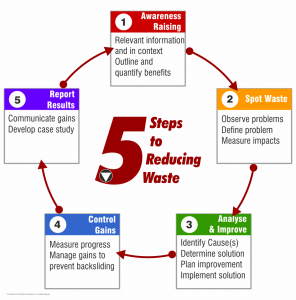
1. Raise Awareness – make sure your colleagues have the right information to make the necessary decisions about waste.
2. Spotting Waste – this is about looking for activities that does not really make a lot of sense. Actions that seemed not to benefit our organisation or people using our products and services. Finally, look for processes that may be out of date or too complex. Get rid of the former and simplify the latter.
Describe the spotted waste clearly with no ambiguities (what is it, where is it, who does it affect and when did it first appear) and then quantify it so that we have an idea of the impacts (for example: 1=low and 5=high).
3. Analyse and Improve – once you spotted the waste, then keep ask “Why?” until you get to the bottom of it. The “becauses” that come with the “whys” offer quick clues to what the solutions can be. Usually 5 rounds of asking Why? should suffice in getting to the root cause, but be pragmatic because the root cause, which may be more staff or a bigger budget, may not always be resolved easily. If that is the case, go back up one “Why” and solve it there.
From the root cause, you should find the solution quite quickly as the “because” tends to lead towards a solution.
Design a timetable; set realistic, sensible and achievable targets; and get on with implementing the improvement.
4. This is when your improvement has worked and you need to make sure it stays that way. You don’t want to solve the same problem again in six months time. Probably the best way is to record the gains from the improvement and then get agreement to turn it into a new working method. Make sure you have clear guidance ready for your colleagues to work the new way.
5. Now you can show off your improvement. Communicate your improvement project upwards to the big boss and sideways to the organisation newsletter. Write up a simple case study to describe it and remember to include a team photo so everyone can look good.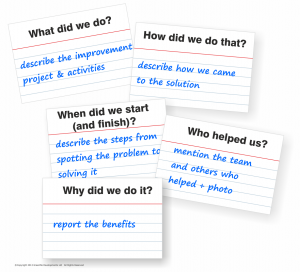
Once you’ve done sustainability this way, you will often notice that people are seeing you as an expert, so it’s time for you to explain to them what sustainability for the rest of us is all about!
For more information on reducing waste, please visit: www.nowaste.org.uk
Uly Ma is the Principal Consultant at Greenfile Developments Ltd, his sustainability programmes were deployed as part of the London 2012 construction programmes. His book, No Waste, is published by Gower/Ashgate: www.ashgate.com
Premier Interlink (Waco UK Ltd) has recently completed a £1.5m contract for the Royal National Orthopaedic Hospital NHS Trust (RNOHT) in Stanmore.
The new Paediatric High Dependency Unit interfaces efficiently with two adjacent buildings and infrastructure, whilst also operating as a standalone facility.
The Brief was to provide a facility compliant with Good Industry Practice, NHS Requirements (with full HTM spec) and all relevant Statutory Requirements.
Working closely with the main contractor and the RNOHT, Premier Interlink constructed the modules with concrete floors in their modern factory in East Yorkshire. The M&E requirements for the facility were designed to fit the modular solution and this meant that full fit out of the plant rooms could also take place at Premier Interlink’s factory.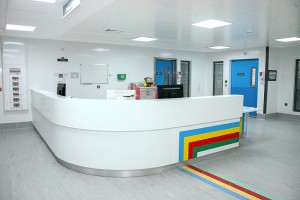
Following manufacture and fit out at their East Yorkshire facility, the modules were transported by road and delivered to site over a weekend, thus minimising any disruption to the day-to-day running of the operational hospital site. The on-site construction of the two storey 13 bay buildingwas completed within a short time frame to ensure the new ward was operational at the earliest opportunity, to satisfy the RNOHT’s requirements.
The Unit has been fully equipped to a high standard and every effort has been taken to ensure the facility can be upgraded as and when required, keeping it operationally efficient for years to come.
The RNOHT installed art work specific to the age of the patients to create a more comfortable environment for their patients’recovery.
The self-contained Unit incorporates all the amenities required to function efficiently and independently and provides accommodation for four patients at any given time. It also includes a fully sealedIsolation Room for specific observation and specialised treatment of patients.
Contact: 0800 3160888 sales@waco.co.uk www.waco.co.uk
Polypipe, the UK’s largest plastic piping systems manufacturer, today (28 May 2013) hosted a special visit from the Minister of State for Business and Energy, the Rt. Hon Michael Fallon MP.
The MP for Sevenoaks toured the Aylesford facilities of the British owned company where he saw at first hand the significant investment and sustainable processes which have contributed to Polypipe’s organic growth in both the UK and overseas, despite the downturn of the construction industry.
Organised by the Construction Products Association, the visit gave Mr Fallon a true insight into British manufacturing and its commitment to innovation and quality standards in order to deliver sustainable and carbon efficient buildings and water management solutions which meet and exceed legislation.
The visit, hosted by Polypipe Group’s CEO David Hall and Commercial Director Adam Turk, began in the 14-acre site’s Centre of Excellence training facility where innovative products were demonstrated and the company’s unique Hydraulic Tower was explored. Mr. Hall then led a factory tour where he explained how the business’ technical support function, combined with a £100 million investment in equipment across its nine manufacturing sites in recent years, had played a key factor in the company’s resilience and organic growth. The resulting success includes contracts to supply plastic piping systems to many of the UK’s most prestigious construction projects, including London 2012.
After the visit Business Minister Michael Fallon said: -Industry figures show the UK construction products sector has an annual turnover of £40 billion, and employs 300,000 people in more than 20,000 companies. It provides materials to build everything from factories and offices to schools and hospitals – essential for both the economy and society at large.
“The Government is working with industry on an industrial strategy for construction that will set out a long term approach to give confidence to business for investment and growth. It also looks at how we can increase exports of construction products, particularly amongst small and medium sized enterprises (SMEs).
“Polypipe are already exporting to Africa and the Middle East and I want to help more companies emulate their success in rapidly growing markets. As a local MP it gives me immense pride to see such an outward looking company based here in Kent.”
Polypipe CEO David Hall added: -Polypipe has a long and proud tradition of British innovation and manufacturing and we are very grateful to Mr Fallon for the time and interest he has shown in our business. The market is extremely challenging but we remain as committed as ever to harnessing our expertise and investing in new product development to supply and support construction projects around the world.
Construction Products Association Chief Executive Diana Montgomery said: -We were pleased to welcome the Minister to the Polypipe site to show him first-hand an example of the economic impact, innovation and sustainable product development our industry is delivering on a daily basis. His support in championing UK construction product manufacturers and suppliers helps to underline the essential role which companies like Polypipe will play in sustaining the economic recovery.
For more information on Polypipe visit www.polypipe.com
In a rapidly moving digital economy and globalised world, governments and local authorities operate in an environment characterised by rapid economic change, rising security concerns and a more demanding electorate. As a result, they face an unprecedented challenge to deliver better and more cost-effective services to both citizens and businesses, providing the public with greater levels of accountability.
In the UK, these pressures are particular intense because of the current squeeze on public sector spending. In line with the digital inclusion agenda, councils and public sector authorities are having to deliver high-quality IT services and solutions not only to their citizens, but also to business and schools across their local area, while at the same time driving efficiencies and keeping costs low.
Barnsley Metropolitan Borough Council (BMBC) is one of the trailblazers in successfully striking this difficult balance. Much of the council’s success as an IT pioneer has been due to the strength of its on-going partnership with solutions provider, Bull Information Systems, a great example of a public-private partnership working positively to create opportunity for the local community.
The original decision to opt to work with Bull followed a best value review of BMBC’s IT provisioning. Having assessed the results, the council decided that to enhance the service it offered to the borough’s businesses and residents it should seek a partnering arrangement.
By outsourcing its IT function, the council was aiming not only to minimise the increasing costs of the ICT function but also to provide a more reliable, secure, responsive and robust IT infrastructure. Further, it was looking to enhance the local economy through the attraction of additional employment into the borough as well as promoting and supporting the use of ICT within the local economy.
After an extensive tender process, the council decided that furthering these objectives would best be achieved by signing a partnership agreement with Bull. The partnership, which is set to run until 2021, involved the establishment of joint venture company, Tuscan Connects Ltd (Bull TCL), which is 20% owned by the Council and 80% by Bull. Running core ICT services, such as desktop and network support, and data centre services, Bull TCL has been created to reduce costs and increase employment.
Partnership in Action
One of the crowning achievements of the partnership so far has been the establishment of a state-of-the-art Tier 3 data centre to replace the council’s existing centre. The previous Tier 1 facility had not had significant investment for more than 20 years and was suffering from an inadequate technical environment with IT equipment that was rapidly becoming obsolete.
In addition to funding the new data centre with a capital investment of £1.5 million, Bull has worked alongside BMBC to create an environment which delivers business agility, flexibility and scalability to companies across the region. This has helped foster the development of a broad range of organisations from start-up entrepreneurs to leading banks to government organisations and schools and colleges, including the Building Schools for the Future programme. It is another excellent example of the benefits of the partnership approach to IT.
For many start-ups in-house IT systems act more as a brake on progress than a catalyst for development. Businesses that grow quickly on the back of a major contract win, for example, will need to take on additional staff and upgrade their office space at short notice. Traditional IT infrastructures invariably struggle to keep pace and small business staff regularly find valuable time is consumed dealing with IT maintenance and upgrade issues.
The quality of the technical infrastructure underpinning the Barnsley data centre provides local business with a much more flexible platform. The state-of-the-art cooling system and the fail-safe/reduction measure have improved the reliability and resilience of the council’s systems.
-Helping drive business success is certainly one of the guiding principles of Barnsley data centre, and IT systems are key to achieving this core goal,†says Philippe Vannier, chairman and CEO, Bull Information Systems. -Bull and BMBC share a belief that IT systems should be a positive enabler for businesses. Ideally, they should offer companies an environment which allows organisations to improve operational processes, drive workforce productivity and support innovative business models. By working in close partnership with BMBC, we are helping to put this important principle into action.â€
The purpose of IT in public sector organisations is often to facilitate different and more efficient ways of working and at times, as is the case in Barnsley, this can mean acting as the catalyst for change. For example, to reduce the cost of having staff based permanently in the office requires an infrastructure that is location-independent and provides a platform to allow for working behaviours to change. Bull TCL plays to this by providing a platform to the BMBC data centre that enables business customers to achieve consolidation, automation and transformation of services without loss of flexibility and control.
Building on the Legacy
The centre now provides a cost-effective, reliable and secure ICT infrastructure which has laid the foundations for improvements in both council services and further economic development in the borough. To date, successes include substantial cost and energy savings under the government’s efficiency agenda as well as the securing of commercial contracts worth several million pounds.
Critically, the centre demonstrates Bull’s commitment to invest and bring innovation into the region, to support local skills enhancement, community regeneration and create business opportunities as the borough embraces digital technology. The centre has excellent telecommunication links including direct connections into the Digital Region network, the first major regional deployment of ‘Superfast Broadband’ in the United Kingdom, which is actively attracting new investments and jobs into the South Yorkshire region.
The pioneering partnership has also attracted much attention from other UK councils who now have the ability to utilise the data centre facilities established. Data centre tenants also benefit from a highly-skilled support team from Bull, acting here as an end-to-end value added service provider, which includes staff working on an accredited service desk all the way through to third line support.
Managing the Journey
In setting up the data centre, Bull is effectively looking to guide local businesses on a journey from in-house, owner-managed IT architectures to hosting, co-location, virtualisation and full cloud computing. Ultimately, this will help transition IT from a cost to a driver of added value for the business. From the IT perspective, there are a range of key benefits for Barnsley’s businesses â€- from virtualisation and rationalisation of IT services to reduced server sprawl and from easier back-up and archiving to reduced time to meet business needs.
Bull’s presence in Barnsley also acts as a platform for another public sector partnership. Bull recently delivered a hybrid managed storage solution to Coventry University. Critically, the University was attracted by Bull’s proposal to split the storage capacity and manage it across two sites: not just at the Coventry campus but also in Barnsley: an approach which the university saw as the best option in terms of efficiently managing risk.
BMBC has been a pioneer council in recognising that high-quality information services and adopting a strong partnership-based approach are vital to operational transformation. With government cuts and an associated scaling down of services across the public sector increasingly impacting councils, it is likely that many more will see IT and partnering with private sector providers as a catalyst for business change.
Network access specialist, The Kenton Group, believes innovative technology is key to the success of the PSN (Public Services Network) Services framework, acting as a catalyst for improved working and public services across the UK. This announcement comes ahead of this week’s Public Services Network Summit, to be held on 2 May in London.
Since 2005, The Kenton Group has partnered with a number of PSN providers and collaborated in the build of over twelve PSN and educational networks across the country. The company is exhibiting at the event as a major technology supplier into PSN networks and continues to support the PSN Services framework by rolling out a number of complex PSN networks using a mix of LLU, EFM, Fibre, Wi-Fi and Ethernet services.
A part of its work on PSN the company has developed a range of products including its innovative ADSL regenerator, Sprint which increases the speed of DSL services (ADSL, ADSL2 and ADSL2+) by more than 50 per cent, delivering high-speed broadband to both existing served communities and un-served communities. Also developed, as part of its widening portfolio, is its Broadband Enabling Technology, which focuses on providing those without broadband access with a reliable connection and service, along with its MAR product range, which is targeted at providing services to traffic controllers, delivering local Wi-Fi services, and improving rural mobile coverage.
John Larkin, Managing Director at The Kenton Group said: -The PSN is an important part of the Government’s IT strategy to reduce infrastructure costs and increase efficiencies across the public sector. Our innovative products and service offerings enable us to support this initiative and we’re pleased to be involved in helping to improve services for communities across the country.
The Kenton Group is also pleased to announce its partnership with Allied Telesis, a world class leader in delivering IP/Ethernet network solutions to the global marketplace, ahead of the event. As such, The Kenton Group is championing the Allied Telesis Eco Friendly switches that are both environmentally friendly and help reduce energy bills by up to 50 per cent.
The Kenton Group has over 30 years’ experience designing and developing network access equipment and connectivity products and solutions for carriers, operators, service providers, enterprises, utility companies and government bodies throughout the UK and around the world.
If you are attending the Public Services Network Summit in London and would like to meet John Larkin, please contact Emma Johnson on +44 1636 812152, or email emma.johnson@proactive-pr.com.
For further information about The Kenton Group, visit at www.thekentongroup.com/, call +44 (0)1322 552 000 or follow @thekentongroup on Twitter.
|
NEED AN UP TO DATE DATABASE? 
|



 Rada’s expertise in delivering robust and sustainable commercial showering and digital washroom controls has been demonstrated through a project at the Ministry of Defence’s Dale Barracks site in Chester.











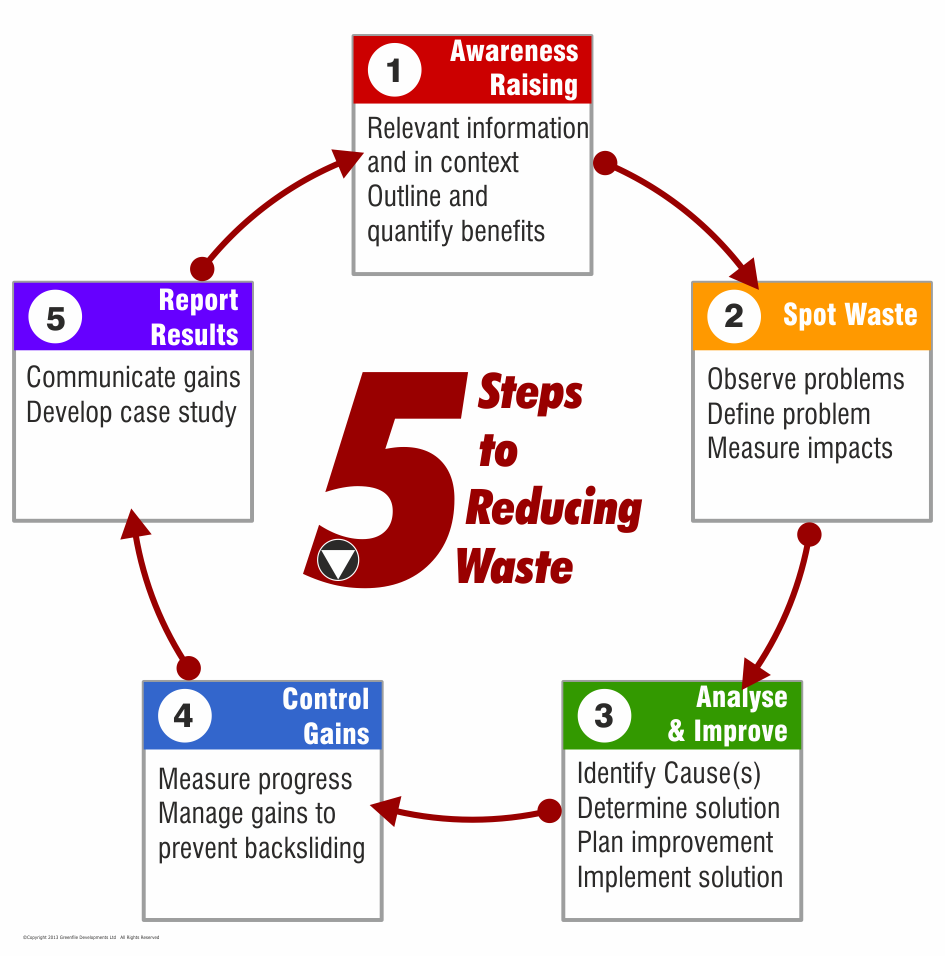
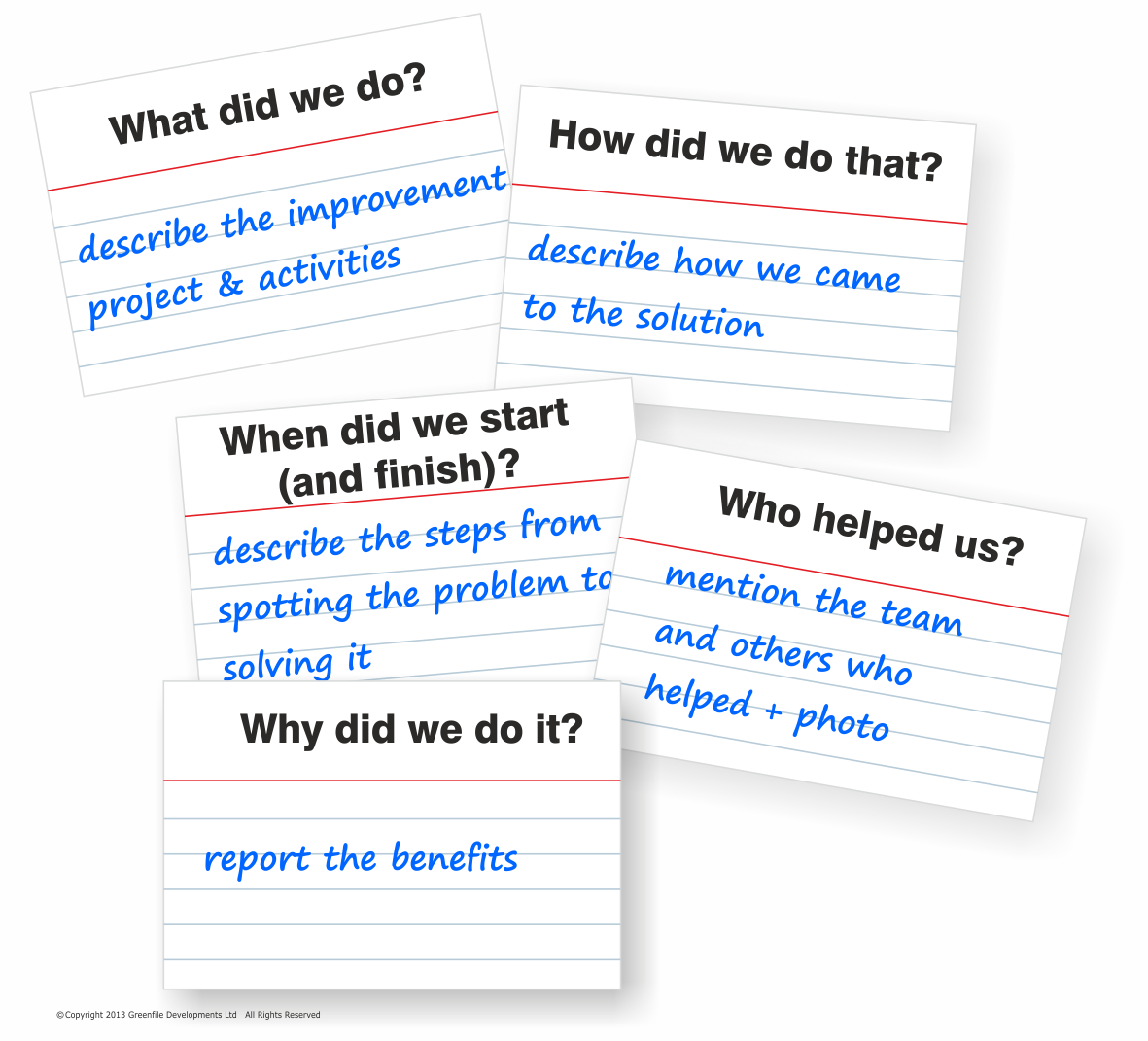
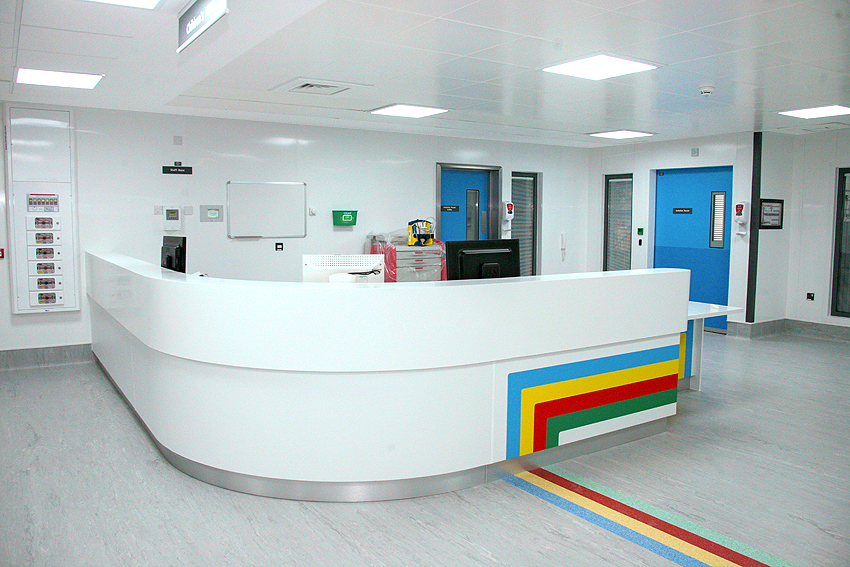



Recent Comments