|
|
Wellspace announce 12 month partnership to provide digital wellbeing services to Guys and St Thomas Charity
Wellspace will be providing digital services for 12 months to Guy’s and St Thomas Charity as part of their staff health and wellbeing programme.
 Guys and St Thomas Charity is an independent urban health foundation. They work with Guy’s and St Thomas’ NHS Foundation Trust and others to improve health in the London boroughs of Lambeth and Southwark, and beyond. Guys and St Thomas Charity is an independent urban health foundation. They work with Guy’s and St Thomas’ NHS Foundation Trust and others to improve health in the London boroughs of Lambeth and Southwark, and beyond.
The Charity focuses on tackling complex health issues that are prevalent locally but also relevant to other urban areas across the UK and internationally.
“As a charity dedicated to improving people’s health, Guy’s and St Thomas’ Charity believes in a proactive approach to supporting the health and wellbeing of our own team. This is in recognition of both the benefit for individuals’ health and the organisation through enhanced motivation and productivity.
As part of our corporate response to Covid-19, we wanted to strengthen our wellbeing programme, particularly around mental health. The Wellspace platform offered what we were looking for in terms of providing a range of tools and resources for individuals which connects into our Employee Assistance Programme. Given the significant impact of the pandemic on our lives and ways of working, it also provides a way for us to monitor, at an organisational level, how everyone is doing. This provides insights that will help us adjust and evolve our programme and ways of working in response to the changing external context.”
Catherine Cullen, Director of Communications and Engagement, Guy’s and St Thomas’ Charity
It is a fact that happy, safe and healthy employees are better engaged, more productive and have fewer absences. This helps grow the bottom line, retain the brightest sparks, and reward staff with the best gift of all; health.
The Wellspace corporate wellness solution works with Guys and St Thomas Charity’ existing policies and activities to bring their best team to work.
Wellspace is a fully comprehensive wellbeing provider and is on a mission to improve mental and physical health and wellbeing by using cutting edge intelligent technologies, real time reporting, data based clinical workshops and seminars and a clear evidence of success and ROI.
“At Wellspace we are thrilled and excited to be working with Guys and St Thomas Charity. The Wellspace solution is well positioned to support the staff with the overall health and wellbeing.”
Jake Adams, Co-Founder and COO Wellspace
The Wellspace Digital Wellbeing Package includes:
- iOS and Android Wellspace smartphone application
- Health & Wellbeing blogs, tips, articles, exercises, challenges

- Company / Sub Account challenges
- Mental Health & Sleep daily digital diary
- Direct chat access to health and technical support
- EAP awareness and signposting
- Local services and resources signposting
- Red Flag alert system for duty of care
- Content management tool
- Online portal dashboard
- Real time reporting
- Health insights and trends
- Push notification tools
- Dedicated account manager
- Technical support
- Regular review sessions and health data insights
- Engagement points, leaderboard and prizes
- Comprehensive roadmap of feature enhancements
We look forward to a long and successful partnership.
For further information please visit: yourwellspace.com/
TWO THIRDS of the public think that vital public services, such as social care, are put at risk when people who can pay their council tax do not, according to a new YouGov survey.
Already hundreds of millions go unpaid every year and over 80% of the public think that this would continue or get worse if local councils didn’t use bailiffs to recover unpaid debts. Unsurprisingly, twice as many adults back the use of enforcement agents to recover Council Tax debts than oppose civil enforcement.
It is vital for local authorities to collect debts that were incurred before the coronavirus lockdown to fill the funding gaps in their budgets. Between March and June, councils incurred £4.8bn of extra costs and income losses. Despite extra central Government funding, local authorities have warned the budget shortfall in England and Wales could top £7.4bn. From Monday 24 August, authorities will be able to use enforcement agents again to recoup outstanding debts when their own efforts to collect money owed have been exhausted. Enforcement agents returning to work will be collecting debts incurred before coronavirus which have been suspended for five months.
 Social care at risk Enforcement agents will not enter homes to take control of goods after visits resume, save for exceptional circumstances and where deemed safe for agents and customers. This policy will be regularly reviewed in line with government and public health guidance. Where agents encounter vulnerable people, additional support will be provided by welfare teams and referral to council support services.
The YouGov survey found that 65% said non-payment puts services, like social care, at risk. Fears are particularly acute among over 65s, 75% of whom thought non-payment puts services at risk, and among Labour voters (69%). More than half of those polled, 56%, said councils should use bailiffs to collect money from people who can pay but won’t. This was more than twice the numbers who said councils should not use bailiffs, at 28%.
Support for enforcement action is highest amongst Conservative voters, 67%, and is above 50% in every region outside London. Almost half of those surveyed, 42%, said that a failure to use bailiffs would lead to fewer people paying their council tax and 39% said non-payment rates would stay the same. Only 5% said it would lead to improved compliance.
The poll was commissioned by CIVEA, the association that represents over 95% of all enforcement agents. Its members collect annually more than £500m of unpaid tax and fines, including £273m in unpaid council tax – enough to pay the starting salaries of over 13,000 police officers.
The survey also found that widespread support among the public for enforcement action for non-payment of court-imposed fines, with 64% of people saying bailiffs should be used. Some 66% of those polled said they supported the current practice of recouping the costs of collecting the debt from the person who owed the outstanding debt.
There are also concerns authorities will face an increase in council tax evasion this year, and 71% of people believe some taxpayers will use the current health crisis to avoid paying their council tax, even though they can meet the payments. Only 10% of people polled did not think this would happen.
Russell Hamblin-Boone, CIVEA Chief Executive, said, “The overwhelming majority of people pay their council tax on time because they recognise non-payment is unfair and puts vital public services at risk. Councils face a deepening financial crisis because of increased costs and lost revenue during lockdown so it is important that civil enforcement work can resume to recover much needed funding for front-line services.
“Enforcement action is always a last resort by councils when other collection measures have failed and, even then, in half of all cases, an affordable payment plan is set up through e-mails or phone calls. CIVEA’s post-lock down support plan will enable civil enforcement to resume safely, ensuring that public health advice is adhered to and the most vulnerable are protected.”
The rapid deployment of healthcare technology has been one of the most commented features of the NHS’ response to the coronavirus pandemic. Yet a significant minority of patients cannot benefit from new, digital services; and risk being overlooked in the rush to go ‘digital first’ in a post-Covid reset. So what can be done to get digital inclusion onto the digital health agenda?
As the novel coronavirus arrived in the UK, the health system moved fast to adopt some kinds of healthcare technology. Trusts implemented remote working solutions and virtual clinics, while primary care shifted almost overnight to phone and video consultations.
As the NHS prepares to ‘reset’ for the winter and another round of reform, most of the focus in the health tech community has been on how it can retain and build on these initiatives. However, a significant minority of patients have not been able to access new, digital services, and there is a danger their needs will be overlooked in the rush to develop ‘digital first’ approaches on the other side of the pandemic.
At its July meeting, Highland Marketing’s advisory board took a look at this issue, with presentations from Anne Cooper, a nurse-leader and technology evangelist, who lives with Type 1 Diabetes, and Roz Davies, the managing director of mHabitat, a co-design digital innovation and inclusion agency hosted by the NHS with a mission to ensure everyone benefits from digitally-enabled health and care.
The tech revolution in diabetes care
Type 1 Diabetes is an auto-immune condition that means the pancreas can produce little or no insulin, the hormone that regulates the storage and use of glucose and fat. This means people living with Type 1 Diabetes – and there are 400,000 of them in the UK – must regularly measure their blood glucose level and take insulin to keep it within a healthy range.
Anne Cooper showed the advisory board some of the technology that she has been given to do this since she was diagnosed with Type 1 in 1979. Back then, testing meant taking a urine sample, mixing it with water, and comparing the results with a colour chart, while her treatment kit included “a syringe, which I had to boil, with re-usable needles, that went blunt, and a bottle of insulin to draw up.”
 Anne Cooper A big step forward was getting an insulin pump small enough to sit in a bra to deliver short-acting insulin through the skin 24-hours per day. While testing improved with the development of testing strips and then the FreeStyle Libre, a sensor that sits on the arm and measures sugar levels in the fluid under the skin.
“For me, the real difference with the Libre was the data it generated,” Anne told the board. Instead of talking about blood glucose levels – always shown as perfect on older product packaging – “we can talk about ‘time in range’ and that is a massive step forward.”
In fact, Anne has just started using another device, called Bubble, to take readings from the FreeStyle Libre, display them on a smartphone app, and send hypo or hyper alerts. Anne showed the board readings from “a roller-coaster day” in which she had struggled to keep her blood glucose levels within range.
While it had been “a difficult day,” she said it showed how “giving data to patients to manage their condition can be quite significant.” However, “and there is a however,” she acknowledged that it isn’t for everyone. The NHS will fund the FreeStyle Libre, but only if patients meet certain criteria and subject to local discretion. Additions like the Bubble must be paid for.
A significant amount of medical, scientific and mathematical knowledge is needed to use these devices and to interpret their data. And patients have to ‘get’ the point of going to so much expense and effort.
“I am quite patient activated,” Anne argued. “I manage my condition. I have embedded the behaviours required to do that in my life. That makes it more likely that I will adopt this kind of technology. Other people will not be in that position. It is the equivalent of culture in an organisation doing EPR. You cannot just give people technology; they have to be able to use it.”
Digital health exclusion, and the challenge of Covid-19
Roz Davies picked up on these points, noting that surveys suggest that around 11.7 million people, or 22% of the population, lack the five basic digital skills that the government believes are essential for every-day life, while 3.6 million are offline and 1.9 million households lack access to the internet.
Many of the people who lack skills or access are older, poorer, and more likely to be disabled. Roz pointed out that these are the groups who are most likely to have significant health and care needs and to be poorly served by existing hospital and GP services. They are also the groups most likely to have been hit hard by the recent pandemic.
“Before Covid-19, around 14 million people lived in poverty in the UK; 8 million people of working age, 4 million children and 2 million pensioners,” she said. “The impact of Covid is likely to have pushed another 1.1 million people below the poverty line, including 200,000 children.
“We also know that death rates from Covid-19 in the most deprived areas are double those in the least deprived areas – probably because people are working in jobs with more dangerous conditions, living in over-crowded housing, and living with underlying health conditions that make them more vulnerable to the disease.”
Plus, of course, people without digital skills or access will have been unable to shop and see family and friends online, or even access education for their children while schools and colleges have been closed. All of which makes it particularly important to make sure that they are not excluded from the next wave of health and care innovation.
 Roz Davies CEO mHabitat However, this won’t be fast or easy. Roz argued that digital exclusion is a classic “wicked system problem” – it is “complex, messy and hard to solve” because addressing any one element tends to change the nature of the problem by impacting on another.
Roz said research and mHabitat’s work had shown there are three domains to address: life circumstances (income, housing etc), digital issues (access, skills, motivation), and system issues (design, staff capabilities and attitudes).
mHabitat is working on a process that local areas can use to address these domains and make sure that groups and individuals are involved at every stage of process redesign, from defining the problem to developing, testing and rolling out a solution.
mHabitat is working on an ‘inclusive digital transformation’ design process that local health and care systems and others seeking to use digital tools and resources can use to address these domains, and make sure that groups and individuals are involved at every stage of process redesign, from defining the problem to developing, testing and rolling out a solution.
In the meantime, Roz said her top five tips were: “1. Don’t start with the tech, start with the people. 2. Understand that people are not part of the problem, they are part of the solution. 3. Use a co-design approach. 4. Gather allies and share experience with other stakeholders. 5. Understand that this needs genuine leadership and investment of resources.”
Discussion: tackling access
In discussion, members of the advisory board felt that some of Roz’s domains should be easier to tackle than others. Andy Kinnear, a former NHS chief information officer working on digital projects while Covid-19 stops him walking the length of Britain, argued the cost of rolling out internet access and skills training would be “bloody peanuts” in the grand scheme of things.
Cindy Fedell, the executive CIO of West Yorkshire and Harrogate ICS, as well as Bradford Teaching Hospitals and Airedale Hospital NHS trusts, agreed: “When we put in sewers, and running water, and trains, and phones, they became a standard,” she said. “I think we need to get into that utilities mindset for technology.”
Other members pointed out that the Smart Cities initiative is trying to roll-out free, public wi-fi, while the NHS has had its own free wi-fi programme that might be replicated by other organisations, such as housing associations.
Andrena Logue, an independent healthcare technology analyst at Experiential HealthTech, suggested that companies running hardware refreshes could be given tax breaks or other incentives to donate devices to organisations that could make use of them.
Or that the NHS could use its not-insignificant buying power to put technology in the hands of end-users. After all, she pointed out, that rapid roll-out of remote working and virtual consultations in the first phase of the Covid-19 response had been supported by national contracts for Microsoft Teams and Attend Anywhere.
 HM Advisory Board Surely, such deals could be “extended or re-imagined” to support specific cohorts of patients?
James Norman, healthcare CIO, EMEA, at Dell EMC, took another tack, by asking Anne Cooper if local services were looking to fund technology by realising the benefit of patients doing some of the work that professionals do.
Anne said there was a case to be made. “I rarely see my team, I look after myself and send them the data, which should fit with the new world of remote consultation.” But the NHS struggles to make it. “The technology is expensive upfront” and studies are not run over a long enough time frame to establish long-term benefit.
Discussion: a small window of opportunity
Nicola Haywood-Alexander, a certified health CIO, consultant, and co-founder of Tech4CV19, picked up on Anne Cooper’s point that “there is no point just giving people technology, they have to be able to use it” and made the case that some barriers could be overcome if technology was easier to use.
“There is something here about design,” she pointed out. “We have standards in the NHS these days for interoperability, so why don’t we have standards for usability?” Roz Davies said she liked this idea, because it spoke “the language of the system.”
But she said there was still a need to address the other domains; to find ways to activate clinicians, motivate people to manage their health and wellbeing, and “engage locally, because that is where the issues lie.”
Members of the board were keen to find ways of getting digital inclusion onto the agenda of their own organisations. Roz advised them to revisit her five top tips. “This is about influencing the areas that you work in,” she said. “Show leadership, find allies and get it on to the agenda.”
There was also agreement that action is urgent. Andy Kinnear said the social solidarity seen in the early days of the pandemic is giving way to some “incredibly selfish behaviour” as people respond to the English government’s “disorganised” lifting of lockdown by crowding into pubs and beaches.
While advisory board chair Jeremy Nettle agreed there was a danger that as Covid-19 came under control people will forget about those vulnerable groups who have been most impacted. “We might not go straight back to where we were before Covid, but this is the moment to talk about digital inclusion, because otherwise we will lose the moment,” he said.
Highland Marketing’s advisory board is: Jeremy Nettle, formerly of Oracle, Cindy Fedell, chief digital and information officer at Bradford Teaching Hospitals NHS Foundation Trust, Andy Kinnear, director of digital transformation at NHS South, Central and West Commissioning Support Unit, James Norman, healthcare CIO, EMEA, at DellEMC, Ravi Kumar, health tech entrepreneur and chair of ZANEC, and Andrena Logue, consultant, Experiential HealthTech.
Highland Marketing is an integrated communications, PR and marketing consultancy with an unrivalled reputation for supporting UK and international health tech companies, built over almost 20 years. Read more analysis and interviews on the Highland Marketing website, follow us on Twitter @Highlandmarketing, or get in touch on: info@highland-marketing.com
 Thousands of SMEs across Scotland are set to benefit from vital free support after the Economy Secretary Fiona Hyslop announced that it was trebling funding for msp Thousands of SMEs across Scotland are set to benefit from vital free support after the Economy Secretary Fiona Hyslop announced that it was trebling funding for msp
The £1.5m of funding is considered a critical lifeline for helping many businesses to overcome the exceptional challenges brought about by COVID-19.
Now in its fifth year, DigitalBoost is a national digital business skills programme which provides businesses with free support to help them take advantage of technologies, improve productivity, increase resilience, and create new market opportunities.
DigitalBoost has received annual funding since being established and this year’s twofold increase underlines the importance of the programme and its role in contributing to the country’s economic recovery.
The funding will run until 5 April 2021 with hopes that it will continue further beyond that.
Fiona Hyslop MSP, Economy Secretary, told GPSJ: “We are focussed on taking immediate action to support our economy as we look to rebuild after COVID-19 and by investing in jobs and digital technology we will create the foundations of a strong recovery for Scotland.
“There is no denying the challenge that lies ahead, but the pandemic has also provided us with an opportunity to rebuild better. COVID-19 has underlined the economic importance of digital capacity and capability – the businesses that have coped best are those who have been digitally capable. By almost trebling funding for the DigitalBoost programme for this financial year, more of Scotland’s SMEs will be able to improve their productivity and reach, while increasing their resilience.”
Welcoming the additional funding, Cllr Steven Heddle, COSLA Spokesperson for Environment and Economy commented: “During this pandemic, Business Gateway’s DigitalBoost programme has repositioned itself to help businesses adapt and survive the Coronavirus pandemic.
“Businesses are vital to Scottish local economies and as outlined in the Government’s Economic Recovery Implementation Plan, digital upskilling and maximising the use of technology will be a powerful tool in helping to bring the country out of this financial crisis. The additional funds for DigitalBoost will allow Business Gateway to add both more and broader digital support to what is already a fantastic service. It will also allow us to help Scottish
DigitalBoost provides local workshops, 1:1 support from a digital expert, online tutorials, and practical guides on topics including social media, cyber resilience, data analytics, digital marketing strategy and e-commerce. Another key component of the DigitalBoost service is a five-minute online health check business can take to assess their digital strengths and weaknesses.
Since the launch of DigitalBoost in 2016:
- Over 36,000 hours of 1-2-1 support have been provided, free of charge, to over 2000 businesses.
- Over 16,500 business owners have attended local workshops and webinars with 94% rating them good or better than good.
- Over 7000 businesses have undertaken a digital health check
- A staggering 22,000+ digital guides have been downloaded – an increase of almost 50% in the past year
- Over 7000 businesses have benefitted from online tutorials
For more information on DigitalBoost and to get support for your business visit www.bgateway.com/digitalboost.
 Reporter: Stacy Clarke Reporter: Stacy Clarke
Cabolo is a brand new addition to Lexacom’s voice-to-text portfolio. It is a unique solution that records and transcribes any conversation with complete security, using the latest AI speech recognition technology. Delivered as a small, portable, standalone unit, Cabolo needs no access to the internet and nothing more than a power source and password to operate. All the complex technology is embedded within the device, completely removing the need for cloud services or third-party data processing.
“Lexacom Cabolo has the potential to revolutionise how conversations are documented. There are no limits to its application; from the HR meeting to the board meeting, from the university lecture to the courtroom” said Dr Andrew Whiteley, managing director of Lexacom.
Once placed in a suitable location, Cabolo can accurately and efficiently transcribe the conversation of multiple people. This reliable and secure solution reduces the administrative burden placed on organisations and increases efficiency, accuracy and productivity.
Cabolo outputs transcribed conversations and video presentations as subtitles in real time and delivers a multimedia PDF with synchronised text and audio, which can be archived and later retrieved using extensive search functionality. Cabolo can be customised to transcribe multiple languages, with specialised vocabularies for different professions or even accents. It can also offer a much-valued tool for those with a hearing or other communication impairment.
Cabolo is ideal for recording and sharing any conversation, business meeting, lecture or video conference. It can also transcribe previously held meetings and conversations. If a recording has been made in a suitable format, the file can simply be uploaded to Cabolo for near instant transcription.
Whilst Cabolo can be used as a stand-alone device, it can also be integrated with existing conferencing equipment, enhancing the capabilities of board rooms, lecture theatres and meeting rooms.
“As the UK’s exclusive provider of Cabolo, Lexacom are now in a unique position to offer the full range of speech technology solutions, whether it be at home, on the move or in the workplace. Cabolo offers an extension to our capabilities that no other company in the UK can claim, bringing world leading AI speech recognition technology to everyone, in any context” said Dr Andrew Whiteley.
Contact Lexacom directly for a detailed demonstration or to discuss further how Cabolo could transform how you and your company work. Please contact 01295 236910, sales@lexacom.co.uk or see www.lexacom.co.uk/lexacom-products/cabolo/
The Lexacom Portfolio
Lexacom 3 is an advanced digital dictation and document creation system designed by professionals, for professionals. With its easy to use workflow management, it helps teams work together. It is the ideal solution for any business looking to evolve current practices and can be configured specifically for any organisation’s requirements or within existing business processes.
Lexacom also provides a wide range of additional services including the latest in professional AI speech recognition, encrypted cloud technology for mobile devices, integrated transcription services and secure cloud based data storing allowing work to be shared across many sites. All of these features will be essential for future working practice.
Echo revolutionises professional speech recognition by using the latest AI technology to produce outstanding levels of accuracy from first use. Lexacom manage and support UK profession specific dictionaries, ensuring Echo stays up to date with not only professional terms, but also acronyms and abbreviations.
Cabolo is a unique solution that records and transcribes any conversation with complete security using AI speech recognition. The small, portable, stand-alone device does not require the internet to work. It is an ideal solution to record and share any conversation, business meeting, lecture or video conference. It provides subtitles in real time and delivers a multimedia PDF with synchronised text and audio which can be archived with extensive search functionality.
Mobile can be used on any handheld device and allows professionals to record, track and approve dictations wherever and whenever they like. Fully integrated with a desktop installation, Lexacom Mobile uses securely encrypted cloud technology to transmit dictations between professionals and secretaries, ensuring data remains safe at all times.
Scribe is an integrated transcription service available at the touch of a button and provides all Lexacom customers with instant access to a UK based, high quality, secure transcription service. This solution is fully embedded within Lexacom 3 and will enable work to be securely transferred, with no additional steps.
Connect is a secure, cloud-based service, allowing document creation at multiple sites, thus sharing resources and increasing productivity and cost savings. The data is stored in a UK-based secure data centre and is encrypted with G cloud security levels and has ISO 27001 certification.
 Stephen Stead By Stephen Stead, director of strategy and digital services at SSE Enterprise’s distributed energy business
COUNCIL officials have shown incredible leadership during the coronavirus pandemic – from supporting vulnerable citizens through to maintaining essential services, local authority workers have been at the forefront, ensuring the wheels of local government keep turning.
Now, many will be returning to their desks for the first time in months. They’ll be greeted by bulging inboxes and in-trays as they begin to catch-up on the projects that had to be put to one side to cope with the first wave of the virus.
Yet, while the backlog of work that’s been piling up during the lockdown will be immense, it is fundamentally important that this does not overshadow the longer-term threat of climate change. With circa three quarters of local authorities having now declared a climate emergency, now is the time to create a “better normal” and not just a “new normal”.
That same leadership that local authorities showed during the lockdown must now come into play in response to the climate emergency. Councils don’t need to do it all. However, they have a key role as a catalyst for decarbonising their local communities and in tandem, stimulating economic recovery and growth.
Boosting the local economy by making buildings smart
The simplest way of reducing carbon is to use less energy. Deploying energy efficiency measures across building stock has the added value of generating work for local contractors. Getting the basics right is an essential first step – from fitting insulation and double glazing to energy efficient lighting. A greater benefit can be achieved through the deployment of low carbon assets such as solar, energy storage, and high efficiency boilers or heat pumps supported by alternative funding models ranging from a basic Salix loan, through Energy Performance Contracting (EPC) to an Energy-as-a-Service model.
In tandem, further benefits can be delivered by making buildings “smart”. Depending on building type and size, this may involve the installation of a Building Management System (BMS) to provide energy optimisation and core control. With or without a BMS, sensor-based services can be applied that utilise measurement, intelligence and control to drive efficiencies. For example, occupancy sensors to tailor lighting and heating or to enable needs-based cleaning.
Smart building technology can also speed-up the return to work following lockdown. They can monitor room and desk occupancy and police separation. Post Covid well-being can also be improved. For example, SSE is installing innovative air purification technology that removes common harmful airborne substances and has been shown to be effective in reducing the infectivity of bacteria and viruses.
Buildings as revenue generators
Reducing carbon comes hand in hand with saving money when it relates to power. Additionally, it can also present a revenue generation opportunity. As the country moves to zero carbon, the penetration of intermittent solar and wind into our power system will increase. However, unlike coal and gas power plants, wind and sun cannot be controlled. Hence the energy system needs a way of balancing generation and load to align to a new world of low carbon generation intermittency.
To achieve this, markets have been established that pay asset owners to turn electrical demand and generation up and down in order to keep the system in balance. A building is essentially a large load. Even more so when heat pumps are installed and EV chargers connected. Where solar and storage are installed, it can additionally deliver controllable generation. As such it can allow organisations such as SSE to control its assets and generate revenues for it. Alternatively, it could simply use this smart control to accommodate local power network constraints and therefore defer investment.
Powering the switch to electric vehicles
Carbon reduction is not just about power. It is also about transport. As the number of EV models on the market increase, so too does consumer appetite to convert although this will remain muted until confidence in availability and speed of chargers increases. In short, to feel fully comfortable with an EV vehicle, charging needs to be a pop-in event, not just an overnight stop. Local authorities can impact this by influencing third party charger deployment. They can also lead by example with their own fleet, incentivise the conversion of grey fleet, and influence EV bus deployment.
There is also a revenue play here. As take up increases, so too will the demand for forecourt style EV charge hubs. By targeting their own fleet and/or that of large local businesses, sufficient anchor demand can be enabled to seed their funding, hence providing convenience infrastructure for the wider community. These hubs can be fed by solar power through private wire, increasing both green credentials and earning potential. They can be done on authority land, fed by authority solar power, or even done in partnership. All of which would generate much needed revenue.
What’s often overlooked is that each of those EVs is in fact a portable battery, so when power isn’t needed to turn its wheels then it becomes a resource that can be plugged into the grid to either store the excess electricity being churned out on windy or sunny days, or to feed energy back into the wider system to meet moments of peak demand, like when everyone turns on the kettle at half time during the cup final, or when the adverts come on during Coronation Street. Each of these events supports wider decarbonisation whilst having revenue generation potential.
Turning up the heat on decarbonisation
Carbon reduction is also about heat. This is undoubtedly the biggest challenge with winter peak heat demand being around four times that of power. This challenge is not simply one of scale. It is also one of technology and cost. Heat networks can be limited both technically and commercially in terms of the number of homes that can viably connect. And where a heat network is not viable, a standalone heat pump is a poor cousin to cheaper, smaller, but, crucially, higher carbon gas boilers. Furthermore, individual property level heat pumps can exacerbate constraints in local power networks and could well result in increased connection costs where deployments cluster.
Due to their economies of scale where densification is sufficient, heat networks are without doubt the preferred choice to decarbonise heat. Their ability to transport waste and recoverable heat, from, for example, industrial processes, water, air, ground and even sewers makes them a powerful tool to help deliver heat decarbonisation. The Climate Change Committee and BEIS see heat networks as playing a crucial role in the pathway to net zero. So how can we increase the number of properties that can viably connect?
The starting point is to consider that, at the same time the government is pushing the rollout of heat networks, it is also encouraging the deployment of both fibre and EV charging networks. Were the local authority to align trenching, the civils element of each element can be greatly reduced, hence improving commercial viability. Where heat pipe building penetration is an issue, building level heat pumps can be deployed. Their associated operating cost can be reduced by connecting to a private electrical network, which, in turn, connects to local renewables, storage, EV chargers, and large local load, providing a local renewable energy system. Not only can the central heat pump that drives the main system be connected to this network, but also the heat network reach can be improved by running spurs off of the private wire network to outlying heat pumps and associated localised smaller networks. These in turn could target pockets of waste heat therefore further improving viability.
Sitting above all of this, is an overarching control system spanning heat, power and transport. This will use heat and power storage and demand flexibility to smooth peaks and troughs and to generate revenues that subsidise the system.
Finally, Energy-as-a-Service funding models can be applied to take the financial pain away by blending asset costs into the ongoing service cost and smoothing this across both heat networks and standalone heat pump deployments.
Covid-19 has accelerated the NHS technology agenda – including a sharp rise in video consultations. But we now need to learn from this to realise a bigger opportunity to create sustainable and intelligent digital patient pathways based on evidence, writes Alan Lowe, chief executive at Visionable
 Alan Lowe, chief executive at Visionable The NHS has had to be very speedy in its technology response to the Covid-19 crisis, witnessing around five years’ worth of digital advancement in as many weeks. We have seen a health service that has changed its appetite for risk amidst the pressure to do things fast and furious when suddenly faced with the challenge of being physically removed from patients. But as the dust settles, the moment to pause and ask the questions needed to ensure services don’t become broken in the longer term is starting to arrive.
Covid-19 will fundamentally change commissioning approaches, forever. It already has. Until now, methods of commissioning pathways have persisted to rely on face to face interactions, with little thought for reimbursing and incentivising people who might want to create a digital pathway that could be life changing for patients and the people responsible for delivering their care.
Now we have a different lens – keeping people safe in their home – a fundamental new driver that will influence how services are commissioned regularly into the future. If we are to do that in an effective, sustainable way, we can’t just throw technology at the problem. We have to ask the right questions about the design of services, about where technology and people fit in that design, and we need to start learning quickly from the answers.
Catching up on five years’ of learning to un-constrain the geography of care safely
With five years’ worth of tech adoption comes an equivalent breadth of learning for the NHS to catch up on.
Video technology is one notable area that has seen tremendous sudden growth as the NHS has had no choice but to adopt it speedily. But the health service now needs to understand where it hasn’t worked, as much as where it has.
People designing services now need to ask how they can intelligently integrate newly adopted technologies like video into the patient pathway, where it is and isn’t appropriate, and what they need to augment video with in order to allow services to fully utilise it.
That means understanding when blood tests, urinary tests or imaging is required, for example. It means asking if some of these examinations could be done by post or when a healthcare facility is required – if that can be a nearby facility to the patient, with other aspects of the pathway at home.
Augmenting that video might mean utilising mobile MRI scanners, approved blood pressure cuffs, Bluetooth scales, and other appropriate devices that could be located in the home.
It means thinking about people too – and particularly for healthcare professionals – whether they have the right skillsets in place so that a nurse visiting a patient’s home can perform various roles that removes the need for different specialists to enter that home. Can that nurse, for example, take a photograph of wound care, that prevents several colleagues unnecessarily entering the house?
It means thinking about a great many variables. And if a multi-disciplinary approach is needed – can we create virtual MDTs that maximise time effectiveness and availability for clinicians and that reduce their own exposure to risk of infection.
In all this we need less haste and more careful consideration as we move at pace – we cannot just throw these things into the wild. We need to employ healthcare system thinking – otherwise we risk doing things fast and breaking things.
We need appropriate devices that collect and provide the right information safely. We need to consider how to onboard datasets. And we need to think about how people use those devices, how it works for the citizen, what data the pathway needs, how that data will be used, how you manage that long term, and create a pathway that is congruent and based on user centred co-design.
The fundamental question to answer is – how can we un-constrain the geography of care safely?
Putting the citizen at the centre
Putting people at the centre almost sounds like a buzzword – perhaps because it’s something people in healthcare have been trying to achieve for a long time.
But if you put the Covid-19 predicament to one side, virtualised pathways still have enormous potential to change lives. And so responses to Covid-19 could now be more than replicating a physical meeting. This is our real opportunity for meaningful change.
Take the redesign of renal pathways as an example. Many people on renal pathways have historically been unable to work or remain in education because of the intensity of interaction with the hospital. They had to go to places – to hospital for tests, meetings and consultations. Virtualising that pathway has allowed people to remain in work or education.
We are now seeing less inconvenience for the patient as pathways start to digitise – from the risk of getting Covid to getting in the car and creating Co2 emissions – the downside of coming into the hospital is being gradually eliminated.But for this to be done safely we cannot rush and buy any old video conferencing tech. We need to create a second generation of teleconsultation where the resources of the healthcare system are configured around the patient’s digital interaction with their providers.
There’s no denying this is a complex piece to solve from a technology point of view and a service provision perspective. We need to start to understand it now, we need to match clinical need to availability and we need to map it and blueprint what good looks like.
Bristow & Sutor, one of the UK’s leading local authority debt recovery specialists, is resuming recruitment and hiring for Enforcement Agents (EAs), Collection Officers and several ad hoc roles within the business. Collections and enforcement agencies have been on the front-line of businesses affected by social distancing measures, but with Government legislation allowing visits to resume next month, the company is looking to grow once again.
Bristow & Sutor already directly employs over 450 people across the UK to provide end-to-end debt collection and credit management support for clients in local and central government, as well as the private sector. The inability to safely undertake visits and inspections in recent months saw EA members of staff furloughed and, despite technological investment ensuring customer support staff remained available, almost all recruitment activity had to be placed on temporary hold.
All furloughed EA staff at Bristow & Sutor have continued to receive training and certification, so they would be prepared to work as soon as it was announced as safe to do so. From a local authority perspective this was essential, as businesses who did not retain staff will now need to recruit to replace, whereas Bristow & Sutor are immediately recruiting to grow. This is especially important when considering the company has recently won a number of key new business projects, including collecting unpaid Penalty Charge Notices at warrant stage for all road charging schemes and traffic enforcement contraventions for TfL (Transport for London).
Many local authorities are keen to resume collections and enforcement activity as soon as possible, to help fill the holes left by loss of revenue streams and to help provide increased support to those impacted financially by the coronavirus pandemic. From Monday July 20th, Bristow & Sutor began supplying reconnection letters to debtors, giving them the opportunity to set up flexible payment arrangements and discuss changing circumstances before services recommence from the 24th August.
Andy Rose, CEO at Bristow & Sutor, says, “At Bristow & Sutor, we remain advocates of the direct model of employment, so we are delighted to be able to resume hiring again. We have already seen a significant number of clients instruct us to prepare for sensitively making visits to their debtors. It is our committed intention, to the very best of our ability, to protect our workforce, ensure the safety of the vulnerable in our community and work with all partners and customers during these uncertain times.”
Bristow & Sutor has been collecting local authority revenue for over 42 years. The business has successfully acquired £6million pounds on behalf of clients during the COVID-19 lockdown and recently won Silver at DCXA’20 in the Digital Transformation and Change category.
www.bristowsutor.co.uk
 SafeGroup Covid-19 disinfection vehicle Reporter: Allan Roach – News
It may look like an unequal contest between a space astronaut and an 23t excavator – but this is how lives are being protected in the construction and quarrying industries.
A decontamination technician from SafeGroup wearing a full body suit and powered respirator gives the excavator long-term protection against Covid-19.
A broad-spectrum electrostatic disinfectant spray destroys the Covid-19 pathogen and bonds strongly to surfaces it is applied to, providing protection against the virus for up to 30 days.
This is helping reduce the risk of Covid-19 transmission via high touch points on construction and materials handling machinery, such as cab door handles and controls.
As the government phases out Covid-19 lockdown measures, SafeGroup, headquartered in London, is working with an ever-widening range of businesses needing to protect premises and equipment against Covid-19.
It is also the first emergency cleaning specialist in the UK to provide Covid-19 surface testing – with results returned by the scientific laboratory within 72 hours.
SafeGroup Chief Executive Officer Steve Broughton said: “The local lockdown in Leicester shows Covid-19 has not gone away. Construction contractors and plant operators need to remain vigilant to protect their teams.
“Data from the Office for National Statistics shows male construction workers have among the highest death rates from Covid-19 in the UK with 25.9 deaths per 100,000 males.
“Construction companies and plant operators are doing all they can to change working practices to maximise protection. But building sites are among the most difficult spaces to make Covid-19 secure.
“This is making the long-term protection against surface contamination that we can provide especially valuable. Regular decontamination work to remove pathogens like Covid-19 could become the new norm for years to come.
 SafeGroup Covid-19 protection excavator “Covid-19 is a gamechanger in terms of workplace hygiene. The expectations of employees and customers on personal safety aren’t being heightened they’re being rocketed through the roof, which is why we’re offering testing to prove workplaces is free if Covid-19.”
The excavator treated by SafeGroup was at a quarry in Telford, Shropshire operated by brick manufacturer Michelmersh. The emergency soft FM specialist is also working with construction companies having to find entirely new ways to work due to Covid-19.
Amy Harris, Group Health, Safety and Training Manager for Michelmersh, said: “We want to ensure a safe environment for staff and customers, along with peace of mind that the working environment is being regularly disinfected and protected.
“SafeGroup’s Covid-19 treatment service has become a key part of our strategy to maintain a low-risk environment and has been welcomed openly by all our staff.”
A poll of 431 onsite construction workers by Construction News magazine found that 40% thought too many people flout new worksite social distancing rules and nearly 40% considered it impossible to stay two metres apart on a building site.
www.thesafegroup.co.uk
 Sascha Giese, Head Geek™, SolarWinds By Sascha Giese, Head Geek™, SolarWinds
While cybersecurity isn’t an immediate casualty of increased complexity, the more digitally transformed public sector organisations become, the more vulnerabilities they face. Similarly, as global workforces have recently moved to their homes, IT teams across every industry have been faced with a rapid expansion of attack vectors. Between this rate of change, increasing complexity, and new devices needing to be secured—and in new ways—we continue to play a seemingly never-ending game of catch-up with the cybercriminals.
These challenges require some concerted changes and improvements throughout the sector. Top of the list throughout this extended work from home period, and the months to follow: security must enter the core competency set of every tech pro, whether as a self-managed skillset or outsourced to an MSP or MSSP. To start, tech pros must develop a complete understanding of the IT environment they support to uncover areas of risk and effectively convey priorities to senior management. That’s in contrast to the situation today where some organisations simply don’t understand the depth of cybersecurity risks they face, or worse still, even realise they may have a problem in the first place.
It may feel as though for every few steps taken towards digital transformation, a few steps are taken back when a cyberattack occurs. As it becomes the everyday norm, what changes can be made in organisations to keep progress on track and reduce targeted attacks?
Cybersecurity Solutions for Digital Transformation
Integrating security systems helps increase visibility into a network and helps organisations manage a wider attack surface. By using applications and devices with built-in security or, if developing an application, making robust security settings the default option, organisations can trust their users will be kept safe from malicious threats.
Teams should also undertake regular penetration testing to identify potential vulnerabilities and opportunities to improve security. While many use log management and signature-based deep packet inspection, attacks can still go undetected, so when using these kinds of solutions, ensure they come with an intelligence feed covering zero-day threats—these threats exploit an unknown computer security vulnerability, i.e., there’s no known security fix because developers aren’t aware of the problem.
Incorporating automation into security processes can help organisations continuously monitor for threats and expand cyber protections, even with limited personnel and resources. Good examples are tools designed to scan web applications from the outside to look for security vulnerabilities such as cross-site scripting, SQL injection, command injection, path traversal, and insecure server configuration. However, it’s not just the tools that are crucial, but the people too, and the communication between them. If information about a possible threat is detected, for example, it should be shared across the organisation, so everyone can take steps to minimise risk.
Upskilling and Training to Keep Everyone in the Know
The importance of cybersecurity skills and training should not be underestimated, because just as gaps can render organisations vulnerable to threats, on the flipside, good training can be an extremely effective supplement to technology-based security solutions. For instance, simple processes such as training staff to recognise emails from scammers can go a long way in avoiding a security breach, and this is an attractive option considering most public sector organisations operate on limited budgets.
For the tech specialists, security is already frequently front of mind. SolarWinds recently shared the findings of its IT Trends Report 2020: The Universal Language of IT, which revealed for 73% of public sector tech pros, at least 10% of their daily responsibilities already include IT security management. This is reflected in the way organisations prioritise their staffing needs, which are now being driven by security and compliance (55%), cloud computing (i.e., SaaS, IaaS, PaaS) (53%), and hybrid IT (37%). Only a collective 18% name emerging technologies—like artificial intelligence, edge, microservices, and containers—as the biggest influence on staffing needs.
At the same time, the top three areas of security skills organisations are prioritising for development include network security (49%), backup and recovery (35%), and security information and event management (SIEM) (29%). This makes sense when you consider organisations aren’t allocating their budget to emerging technologies—particularly as this year’s budgets are re-evaluated in the face of economic challenges. In the same study, nearly two-thirds (62%) indicated their organisation’s tech budgets allocate less than 25% of their spending to emerging technologies.
Technology professionals could, if possible, take advantage of any quiet times and prioritise their own training through upskilling, which would help to maintain good cybersecurity standards and keep digital transformation on track. In addition, it’s important the country’s public sector tech pros start to add a new organisational language to their realm of expertise—the language of business. In seeking a seat at the executive table, tech pros can put cybersecurity and digital transformation higher on the business agenda.
Outsourcing or Insourcing?
Maintaining a solid cybersecurity posture is hugely important for every organisation, but in the public sector, where budgets and resources can present barriers to progress, another option to consider is outsourcing the cybersecurity function to an expert or deploying a managed software solution.
Many organisations are now opting to outsource their cybersecurity, as the benefits gained through this often outweigh the costs. With a third-party involved, organisations have access to the latest technologies and software available to tackle the ever-increasing threats. Along with this comes the experts themselves—people who live and breathe security day in, day out. Teams of experts are typically available 24/7, allowing for a rapid response to security lapses or vulnerabilities, regardless of the time of day or night. When the entire country relies on the public sector, knowing this level of security expertise is always available is a comforting reassurance.
Alternatively, for those either lacking the budget for outsourcing or who’d feel more comfortable relying on their own teams, managed software solutions could be the safest option. These vary between vendors, but most should deliver intelligence to proactively identify threats, take automated action to mitigate damage, and analyse data to prevent future attacks from occurring. Though the best solutions on the market will be very expensive, the different packages on offer may be more affordable than outsourcing—though the onus will be on the organisation purchasing the software to manage it and act on the information it produces.
Whichever way you look at it, security should be a core competency. Being ready for worst-case scenarios is crucial in maintaining a strong defence, so it’s important to find and implement easy-to-use, affordable, and scalable security solutions to work across the varied IT environments found across the public sector.
Reporter: Stuart Littleford
The Covid–19 pandemic has not only caused worldwide deaths and suffering but has also resulted in a dramatic change in healthcare working practices. In the post Covid–19 world, there will need to be a re-evaluation of how healthcare is delivered and managed. There will be more reliance on remote working together with the need for efficiency and flexibility in working practices. With the whole of the NHS focused on the pandemic, there are now hundreds of thousands of non-Covid-19 patients waiting for primary care referrals and secondary care clinic appointments, not to mention surgery waiting lists. This equates to an avalanche of referrals, letters and other documents which will need to be created quickly, efficiently and accurately.
Document creation is fundamental to the healthcare system, whether it be from the clinic or from home during telemedicine consultations, by secretaries typing out letters or using speech recognition to automate document creation. The UK-based company, Lexacom, is ideally placed to help support these changes by leading the way in digital dictation, speech recognition, remote transcription and document management.

“In the coming months, the backlog of non-Covid-19 patients is going to place a further strain on UK healthcare administration. Lexacom is proven to increase efficiency and speed up turnaround times of referrals, letters and other documents. NHS trusts require quick answers as soon as possible and Lexacom provides the security and accuracy that medical professionals need. Our solutions can also be instantly accessed and embedded into existing admin systems and can be used remotely. This will be essential for future working practice” said Dr Andrew Whiteley, Managing Director, Lexacom.
Lexacom has been delivering workflow solutions to the healthcare, legal and professional markets for the last 20 years. Their vision is to help organisations around the world increase their professional productivity and to drive operational excellence through innovative, reliable and cost-effective solutions.
Furthermore, Lexacom has recently been included in the newly released NHS SBS Digital Dictation, Speech Recognition and Outsourced Transcription Framework. This allows NHS trusts and other healthcare organisations to directly access Lexacom’s portfolio of software and hardware.
With over 60% of general practices using their software, Lexacom are in the unique position of improving the links between primary and secondary care and to support the NHS during these challenging times. “Being included on the SBS framework further strengthens the long-standing relationship we have as a trusted and approved partner within the healthcare sector and we are proud to be recognised for this” said Dr Whiteley.
During this pandemic, healthcare delivery has changed to cope with the unprecedented situation. In the post-Covid-19 world, changes that have been instituted will need to be developed to provide the best service for patients, improve workflow and efficiency and to keep both staff and patients safe. Lexacom has a proven track record of delivering this by ensuring easy access to world-leading digital dictation, AI speech recognition and remote transcription technology.
For further information, please contact 01295 236910, sales@lexacom.co.uk or see www.lexacom.co.uk.
The Lexacom Portfolio
Lexacom 3 is an advanced digital dictation and document creation system designed by doctors, for doctors. With its easy to use workflow management, it helps professionals and their teams work together. It is the ideal solution for any healthcare facility looking to evolve current practices and can be configured specifically for any organisation’s requirements or within existing medical admin systems.
Lexacom also provides a wide range of additional services including the latest in professional AI speech recognition, encrypted cloud technology for mobile devices, integrated transcription services and secure cloud based data storing allowing work to be shared across many sites. All of these features will be essential for future working practice.
Echo revolutionises professional speech recognition by using the latest AI technology to produce outstanding levels of accuracy from first use. Lexacom manage and support a UK specific healthcare dictionary for their clinicians, ensuring Echo stays up to date with not only medical terms, but also professional acronyms and abbreviations.
Cabolo is a unique solution that records and transcribes any conversation with complete security using AI speech recognition. The small, portable, stand-alone device does not require the internet to work. It is an ideal solution to record and share any conversation, business meeting, lecture or video conference. It provides subtitles in real time and delivers a multimedia PDF with synchronised text and audio which can be archived with extensive search functionality.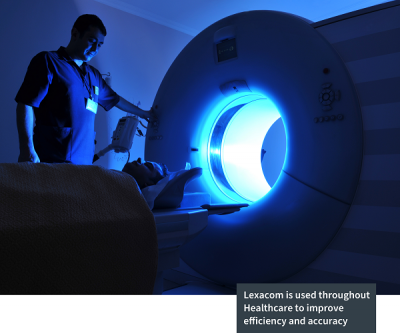
Mobile can be used on any handheld device and allows professionals to record, track and approve dictations wherever and whenever they like. Fully integrated with a desktop installation, Lexacom Mobile uses securely encrypted cloud technology to transmit dictations between healthcare workers and secretaries, ensuring data remains safe at all times.
Scribe is an integrated transcription service available at the touch of a button and provides all Lexacom customers with instant access to a UK based, high quality, secure transcription service. This brand-new solution is fully embedded within Lexacom 3 and will enable work to be securely transferred, with no additional steps.
Connect is a secure, cloud-based service, allowing document creation at multiple sites, thus sharing resources and increasing productivity and cost savings. The data is stored in a UK-based secure data centre and is encrypted to the highest NHS and G cloud security levels.
The Lexacom Story
Like all great companies, Lexacom was created to solve a problem. Working as a busy GP partner in the 1990’s, Dr Andrew Whiteley was constantly frustrated using antiquated, unreliable dictation recording machines and tapes for creating letters and patient referrals. The numerous problems associated with this way of working inspired Andrew to develop one of the first digital dictation programs. Designed to be easily used by everyone, even the most technophobic senior partner, his practice quickly embraced the new technology.
Word spread and enquiries started to flood in as practices heard about the solution and wanted to use it. At this point, Andrew and his founding partner, Dr Matthew Tytherleigh, decided that Lexacom should be developed into a business.
Two decades later, Lexacom has thousands of customers, tens of thousands of users and a platform of five innovative solutions used to make millions of documents every year, across three continents. Lexacom is one of the most exciting software companies in the UK and with Andrew still the Managing Director, Lexacom has been able to stay faithful to those early ideals of addressing the needs of the user.
Lexacom customers are passionate supporters of the user-friendly software and the inclusive approach to new feature development. There is constant evolvement and refinement of the solutions that are offered in response to customer feedback. Although the company’s early foundations were in healthcare, Lexacom’s approach and ease of use has meant its software is favoured by busy professionals including lawyers, accountants, local and central government, surveyors and estate agents.
Lexacom is based in Banbury, Oxfordshire, serving clients throughout the UK and Europe. With several forward-looking partners, Lexacom also distribute their software throughout the Middle East and Australia.
The Zhaga interface standard for street lighting future-proves luminaires to keep pace with rapid developments in digital technology. It enables a multi-vendor eco-system of interoperable luminaires and sensor/communication modules and breaks existing barriers to smart and connected lighting.
The Zhaga smart interface specifications will have a major impact on the value of the lighting infrastructure for connectivity and on the investment decisions of city governments, specifiers and utility companies. It will drive innovation in in sensor/communication modules incorporating new smart applications.
Zhaga is an open and global consortium of lighting companies that creates interface standards for components of LED luminaires. Zhaga so enables multi-vendor eco-systems of interoperable products.
Zhaga has now applied its vision to connectivity and smart streetlighting. The standard in the Zhaga Book 18 was published in November 2019 and is called “Smart interface between outdoor luminaires and sensing / communication modules”. This standard defines a smart luminaire interface, including mechanical socket and communication and control aspects, so that a sensor/communication module can be externally mounted on the luminaire supported by plug-and-play. The interface is in this respect similar to the USB slot on a computer.
This short paper describes the vision leading to the standard, the standard itself, certification aspects, and ends with a brief conclusion.
Connectivity vision
The increasing digitisation in many areas of our society presents new challenges to manufacturers, specifiers, installers and users of lighting installations. The long lifetime of outdoor lighting is very difficult to match with the dynamic developments in digital technology.
This inability to combine the long-lasting nature of the lighting infrastructure and the rapid changes in digital communication and sensor technology has led to an underutilization of the lighting infrastructure for smart applications and has regrettably reduced the solution toolbox for smart city and smart buildings. This has hampered progress in this space.
To resolve the challenge and secure a central place for lighting in smart city, a connectivity solution for lighting should at least meet the following requirements. From a functional point of view, the solution should enable the lighting to connect to the IoT, enable light management through control and energy and status reporting, and support beyond lighting applications.
From a more methodological point of view, the solution should be future proof and easily upgradable to keep pace with rapid developments in digital networking technology. It should also be based on standards to avoid vendor lock in.
Zhaga solution
Zhaga has now addressed this problem by creating a new interface standard for outdoor luminaires. This standard turns the streetlighting infrastructure into a strong enabler for smart cities.
The Zhaga standard for smart streetlighting defines a smart luminaire interface which includes both a mechanical socket and communication and power aspects. It allows a sensor/communication module to be externally mounted on the luminaire and supports plug-and-play. The interface is in this respect similar to the USB slot on a computer.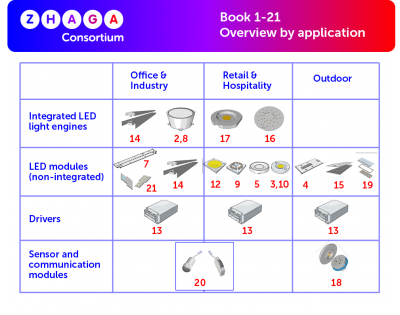
Luminaires with the Zhaga interface can be equipped – in field – with sensor/communication modules to extend their initial functionality. In one case, the module includes radio communication, and enables remote light control and the transmission of diagnosis and energy data to a central management system. In another case, the module includes sensors. In yet another case, the module includes even more advanced smart city applications for e.g. city security of environmental control.
Certification
The Zhaga vision on connectivity hinges on the interoperability between luminaires and sensor/communication modules of multiple vendors.
To create trust in interoperability, Zhaga has defined a certification program to accompany its standards. The program is carried out by independent test houses and the certification status of products can be verified though a publicly accessible database and though logos which are trademarked to prevent misuse.
The logo also presents business advantages to end-users, as it encourages a wide supply of innovative solutions and multi-vendor sourcing options. For manufacturers, the certification logo offers a strong marketing tool, and shows that the product derives added value from a strong product eco-system.
Conclusion
The Zhaga interface future-proves a luminaire and ensures that it can keep pace with rapid developments in digital networking, sensing and smart-city technology. Modules incorporate the developments and are easily replaced. An installed base of luminaire with the Zhaga interface drives innovation in the module market; innovations in the module market add value to the lighting infrastructure. A certification and logo program create further trust in the interoperability of luminaires and nodes from different vendors.
The Zhaga smart interface standard for streetlighting, the Zhaga Book 18 was published in November 2019. First certified products and infrastructure installations are now available. Zhaga will shortly publish a standard for indoor lighting, based on an approach comparable to the one used for outdoor.
For further information please visit: www.zhagastandard.org
Global CEM Leader that Provides Software to Top Multinational Brands like Goldman Sachs, Tiffany & Co. and Nokia, Expands its Award-Winning Platform to Europe
CEM Platform Helps Employers and Governments Conduct Coronavirus Contact Tracing and Critical Communications for a Safer Return to Offices and Other Public Spaces
Registrations Now Open for Virtual Executive Panel Discussion and Product Demo on June 17th
Everbridge, the global leader in critical event management (CEM), today announced the expansion of its award-winning software platform in Europe, just as businesses, healthcare facilities and governments focus on the safer return of people to offices and other public places following COVID-19 lockdowns, and navigate multiple crises at the same time—spanning the coronavirus pandemic, active shooter situations, terrorist attacks, severe weather, supply chain disruptions, IT outages, cyber-attacks and other incidents.
Over 5,000 global firms rely on Everbridge to keep their people safe and organizations running in anticipation of or amid critical events, whether natural, digital, or manmade. The Everbridge CEM solution provides an integrated, end-to-end approach for managing all phases of a critical event, accelerating the time to identify and resolve threats, and providing a unified, organizational view to facilitate more coordinated action. CEM helps organizations, such as Goldman Sachs, Tiffany & Co., and Nokia identify and assess the severity of events; determine their relevance to an organization’s people, assets, suppliers, and supply chains; automate taking action to mitigate threats and track progress; and analyze performance to improve future response. The Everbridge CEM solution leverages 225 out-of-the-box, pre-existing integrations, more than 100 communication modalities, and 22,000 risk data sources to provide a unified enterprise-wide, end-to-end platform that digitally transforms the critical event management process. For customers currently using Everbridge software-as-a-service (SaaS) applications in Europe, the common architecture allows for seamless and rapid upgrades from the existing point solution to the full CEM suite.
Everbridge CEM also includes COVID-19 Shield™: Return to Work and Contact Tracing, which help organizations manage the complex process of returning to the workplace and other public spaces during the pandemic. This turnkey solution incorporates a specialized coronavirus-specific data feed to alert on new outbreaks, changes to local policies, and transportation / production disruptions that could hinder supply chains. It also offers quick-start templates and integrated modules to Know Your Risks, Protect Your People, and Protect Your Operations and Supply Chain. Organizations can get up and running in 48 hours or less. To date, customers have used the Everbridge platform to deliver over 400 million COVID-19-related communications.
“There has never been a more important time for organizations to manage risk, communicate with their employees and get people back to work safely,” said Javier Colado, Head of International, Everbridge. “Adopted at enterprise scale by a growing number of organizations in the U.S. and now available in Europe, Everbridge’s critical event management solution provides a comprehensive approach for leaders planning how to recover from the COVID-19 crisis and manage the many threats that continue to occur at the same time. This CEM launch will both benefit organizations headquartered in Europe and multinationals who operate there.”
 Everbridge’s CEM expansion offers several new enhancements tailored to Europe: enriched risk data leveraging the world’s largest vetted database of threat incidents, severe weather tracking and updates, transit disruption updates, and an expanded database of key points of interest including nearby hospitals and embassies. These new data sources benefit multinationals using CEM worldwide, as well as Europe-based organizations. Everbridge’s CEM expansion offers several new enhancements tailored to Europe: enriched risk data leveraging the world’s largest vetted database of threat incidents, severe weather tracking and updates, transit disruption updates, and an expanded database of key points of interest including nearby hospitals and embassies. These new data sources benefit multinationals using CEM worldwide, as well as Europe-based organizations.
“At Accenture, the safety and well-being of our people is always our top priority. So it’s important that we have the ability to reach our people quickly wherever and whenever they face a potential threat to their security,” said Arlin Pedrick, Chief Security Officer, Accenture. “Our Emergency Management System has proven to be invaluable in supporting our people before, during, and after a significant event.”
In addition to more than 1,000 customers in Europe, Everbridge also provides Public Warning systems on a countrywide level and is the only company with five European countries deployed, including Norway, Sweden, the Netherlands and Iceland.
The Everbridge CEM solution is available today and complies with major data regulations, including GDPR, ISO 27001 and C5 in Germany.
Siemens and Finastra to Speak at Launch Event on June 17
Everbridge will demonstrate its newly expanded CEM solution on June 17, 2020, during a special virtual executive summit. Finastra CEO Simon Paris will deliver a keynote speech on how his global firm, the third-largest Fintech company in the world, uses the technology to keep staff safe. Finastra uses Everbridge to significantly reduce the time it takes to respond to IT incidents on its applications and to respond to external crises.
Other speakers at the summit include:
- Arlin Pedrick, Chief Security Officer of Accenture, who has responsibility for protecting hundreds of thousands of employees worldwide
- Marco Mille, Chief Security Officer of Siemens, #62 on the Fortune Global 2000 and a leading supplier of systems for power generation and transmission, as well as for medical diagnoses
- Andy Cox, Partner, Crisis & Security Consulting, Control Risks, a global risk consultancy firm with 36 offices that has established a CEM practice
- John T. McRae II, Group Vice President & General Manager, Syniverse, the world’s most connected company™
Limited registrations for the special event are currently open. Please register for the event here.
Everbridge also recently hosted its “Coronavirus: the Road to Recovery” virtual leadership summit, which brought together the best minds across public and private sectors, including C-level speakers from the The Centers for Disease Control (CDC), Cleveland Clinic, U.S. Army, Accenture, Biogen, The NBA’s Boston Celtics, a former Food and Drug Administration (FDA) commissioner and more. On-demand content from the event may be found here.
 Tillr’s director, Paul Romer-Ormiston Reporter: Stacy Clarke – Sponsored
It is acutely ironic that 2020, a number associated with complete clarity of vision, is a year of unmatched confusion when it comes to looking into the future. Given the unprecedented nature and scope of the restrictions imposed in response to the Covid-19 pandemic, nobody can claim any expertise in knowing what happens next.
However, it can be stated with certainty that the organisational and logistical challenges associated with the relaxation of lockdown will be enormous.
Local government will be faced with a fiendishly difficult task in overseeing and implementing measures introduced by Whitehall.
As a developer of a software platform that facilitates the rapid digitalisation of operational and regulatory procedures, we have experienced requests from many of our local authority clients for content related to Covid-19 to be added to their accounts. They need help protecting their staff, the public and local businesses.
We have responded by offering a Post-Lockdown Recovery Toolkit, which will help with the creation and maintenance of Covid-secure workplaces, open spaces and local amenities.
In the five years since Tillr was founded in 2015, our eponymous platform has become a trusted name in the sphere of digitalisation of local authority processes, with more than 20 councils across London and the South-East using us to digitalise their operations in areas such as sports and leisure, waste management, parks and open spaces and highways.
Councils see a reduction in administrative tasks, followed by a gradual improvement in the way they understands their own data through enhanced analytics. Every client is different – and the platform is designed to be highly configurable to cater for the particular circumstances of each organisation and the use they wish to put it to.
It is the flexibility of the Tillr platform that will be a crucial facet of the Post-Lockdown Recovery Toolkit. Each local authority will face varying challenges when the time comes to implement and monitor activities after restrictions on people’s movement are relaxed.
Our toolkit contains templates that will help with areas such as social distancing, the unauthorised opening of premises and the implementation of policies relating to new rules governing locations such as shops and restaurants. Speed is key. This is an asset that can be delivered quickly – and updated fast too. If an announcement in Westminster changes social distancing parameters at 5pm, that will be reflected in our service by 9am the following day.
The toolkit has already been used to good effect, as one London borough was concerned about breaches of social distancing guidelines in its parks and decided to start monitoring. We added a template to its Tillr account within 24 hours of receiving the request so that the council could record instances of breaches.
There has been a considerable interest in this product across the public sector, with discussions being had with the Mayor of London’s office, the Greater London Authority and several boroughs in the capital, as well as Sussex Police.
This asset has not been produced as an opportunity to exploit the desperation for solutions in the post-Covid world. We want to make it as easy as possible for local authorities to access the toolkit and trial it. It will be a useful tool for the public sector so we are making is available quickly and on a non-profit basis.
To underline this, existing council customers – more than 20 bodies across the South-East – will be offered the toolkit completely free for 12 months, provided they agree in advance to contribute to the content on the platform.
Tillr is already actively preparing to develop a separate version for police forces, whose requirements will be different to those of councils and is currently in discussions with several Police forces, one of which is already taking advantage of the Tillr platform.
A version of the Toolkit will also be of help to educational establishments such as schools and nurseries, where the application of social distancing restrictions will be particularly challenging.
Contact us today to access the toolkit
We are in discussions with existing clients already. But for those new to Tillr, the best way to register your interest is to contact us on hello@tillr.io or via our website.
We suggest getting in touch as early as possible so that you can be ready to implement and monitor post-lockdown restrictions as soon as they are in place.
Reporter: Stuart Littleford – News
David Frost, Chief Negotiator has spoken to GPSJ on the conclusion of the fourth round of negotiations with the EU on our future relationship.
He said: “We have just completed our fourth full negotiating round with the EU, again by video conference. It was a little shorter than usual and more restricted in scope. We continue to discuss the full range of issues, including the most difficult ones.
“Progress remains limited but our talks have been positive in tone. Negotiations will continue and we remain committed to a successful outcome.
“We are now at an important moment for these talks. We are close to reaching the limits of what we can achieve through the format of remote formal Rounds. If we are to make progress, it is clear that we must intensify and accelerate our work. We are discussing with the Commission how this can best be done.
“We need to conclude this negotiation in good time to enable people and businesses to have certainty about the trading terms that will follow the end of the transition period at the end of this year, and, if necessary, to allow ratification of any agreements reached.
“For our part we are willing to work hard to see whether at least the outline of a balanced agreement, covering all issues, can be reached soon. Any such deal must of course accommodate the reality of the UK’s well-established position on the so-called “level playing field”, on fisheries, and the other difficult issues.”
Reporter: Allan Roach – News
Bristow & Sutor is excited to announce that they are now working with Transport for London (TfL). Since May 1, 2020, Bristow & Sutor has been collecting unpaid Penalty Charge Notices at warrant stage for all road charging schemes and also traffic enforcement contraventions.
Bristow & Sutor is one of the UK’s leading players specialising in debt recovery and has over 42 years’ experience in the collection of local council tax, non-domestic rates and unpaid Penalty Charge Notices.
Winning the debt management and enforcement contract with TfL has resulted in the production and implementation of new letters, business rules, action codes and reports. Bristow & Sutor employees have adapted their own processes to fully immerse themselves in the TfL way of working, strategically positioning their service delivery to reflect an extension of the iconic TfL brand.
Investment in the use of technology is key to the Bristow & Sutor approach and success of recent years. The company has a range of innovative portals, apps, and debt recovery tools which gives debtors an easy, secure way of making online payments; resulting in efficient route information to aid the reduction of Enforcement Agents (EAs) carbon footprints.
Bristow & Sutor has delivered the new TfL project against challenging milestones, hitting every deadline required, and now see this success as a prime example of the company’s capability and reliability when implementing new contracts and transferring existing needs painlessly.
Andy Rose, CEO at Bristow & Sutor, says, “Bristow & Sutor is delighted to be embarking on a new partnership with TfL. Our aim is not only to successfully action existing cases, but to be recognised as the number one performer and innovator throughout the duration of this contract. Winning new contracts such as TfL, means significant expansion and job opportunities over the coming years. We already directly-employ over 168 EAs around the country.
“Our talented and hardworking team has worked painstakingly over the past weeks and months to ensure this project will perform optimally. Coupled with the unprecedented interruption of COVID-19, it has been a remarkable achievement by our tremendous team to ensure we a ready and raring to go”.
Regarding COVID-19, in accordance with the Government measures to combat this virus, EAs are not being deployed until social distancing measures have subsided. However, Bristow & Sutor has undertaken a massive mobilisation exercise to help foster a ‘business as usual’ approach, albeit without enforcement visits. Portals, apps, emails, telephone lines and debt recovery tools all remain accessible for debtors who need to discuss their situation. Consequently, the company has already been able to begin the compliance process for this new project with TfL.
Bristow & Sutor prides itself on delivering an ethical, compliant and high-quality service to the public and private sectors. Agents regularly assist debtors with completing questionnaires, setting up payment arrangements and directing them towards support and advice where appropriate. They are trained to the highest standard and use modern technology and data to achieve market-leading performance, whilst protecting the most vulnerable in society and the reputations of clients.
www.bristowsutor.co.uk
Reporter: Stacy Clarke – News
If you are an energy app developer or energy innovator; a local authority energy manager or an electric vehicle (EV) charging provider; a grid or micro-grid operator; an academic or one of the many other energy-interested individuals or organisations, Siemens would like to hear from you. You can have your say on what you need from a national energy data platform and how you want to access it.
 Siemens have won a project with the UK Government’s innovation-agency, Innovate UK, to develop an energy data platform. The platform, Your Online Digital Architecture (YODA), will integrate sources of information throughout the energy system and curate a central energy data catalogue, an energy map of generation and demand, and an asset register for all new energy assets, such as electric vehicle charging points, wind and solar farms. Siemens have won a project with the UK Government’s innovation-agency, Innovate UK, to develop an energy data platform. The platform, Your Online Digital Architecture (YODA), will integrate sources of information throughout the energy system and curate a central energy data catalogue, an energy map of generation and demand, and an asset register for all new energy assets, such as electric vehicle charging points, wind and solar farms.
Siemens will run a series of workshops throughout early June to understand key stakeholders’ needs and ensure these are reflected in the future platform design and fully support projects being carried out by energy producers, distributors and consumers. A concept design for the data platform will be shared openly toward the end of the initial discovery phase in mid-July. This work will build on Energy Data Best Practice and the Energy Data Taskforce to establish an industry baseline of research which could be practically utilised by businesses and organisations throughout the UK to expedite digitalisation and develop products and services to improve energy efficiency in generation and usage.
Siemens, together with partners Energy Systems Catapult and National Innovation Centre for Data, is creating Your Online Digital Architecture (YODA), a national energy data platform for Innovate UK’s Modernising Energy Data Access project
YODA will enable better local energy management and support the drive to decarbonisation by providing a central energy data catalogue, an energy map of generation and demand, and an asset register for all new energy assets such as wind and solar farms, electric vehicle charging points etc.
Energy innovators, generators and users can tell Siemens how they want to use the energy data platform through a series of on-line workshops early in June
2030, the UK’s target date for Net Zero is less than a decade away. Most of the assets and technologies that make up the energy system of today will be present in the future decarbonised system, albeit facing increasing strategic and operational challenges with the continued rise of distributed energy, electrification and digitalisation. The Modernising Energy Data Access (MEDA.) project was established by Innovate UK in autumn 2019 and invited competitive bids for projects to solve the fundamental problem of exchanging digital energy information between disparate stakeholders to enable the development and testing of products and services which can be commercialised and scaled. Siemens, with its partners Energy Systems Catapult (ESC) and National Innovation Centre for Data (NICD), is one of three successful entrants through the first round and going forward with developing their project concepts.
Andrew Smyth, Head of Customer Success, Software at Siemens, explains “We are very excited to be working on the MEDA project and are passionate about creating a platform to enable both visibility of the national energy system and to support the drive to decarbonisation. The workshops will explore how energy users are challenged and constrained by the current energy system and how a central data platform could aid their future aspirations. The workshops are planned to allow all participants an opportunity to express their views”.
Dr. Richard Dobson of Energy Data Taskforce adds “Energy Systems Catapult’s mission is to unleash innovation and open new markets to capture the clean growth opportunity. The ability to seamlessly share and access data is absolutely fundamental to this. We’re excited to be working with Siemens on Your Online Digital Architecture to deliver a critical part of the modern, digitalised energy system we need.”
Details of the workshops, which all run between 1st June and 9th June at 9.30am and 1.30pm on the 3rd, 4th, 8th and 9th June plus 9.30 on Friday 5th June, are available on the project website www.siemens.co.uk/yoda.
Reporter: Stuart Littleford – News
Only sterling denominated money market fund exclusively for the public sector
Client-owned fund manager CCLA today announces that its Public Sector Deposit Fund (PSDF), a money market fund, reached £1 billion of assets under management on 3 June 2020 for the first time since its launch in 2011.
The fund’s investor base is made up of 550 parishes, towns, districts, boroughs, counties, pension funds, police, fire authorities and housing associations amongst others.
Peter Hugh Smith, CCLA’s Chief Executive, told GPSJ:
“I’d like to thank all of our clients who have helped us to reach this milestone. A larger fund enables us to increase our lot sizes, to achieve even greater diversification and command better rates in the sterling money markets. This in turn means all clients benefit from the fund’s growth which is so important during these fiscally-challenged times.” 
The Covid-19 crisis is hitting many of the regular income streams councils rely on at a time when councils are having to spend more addressing issues associated with the crisis. To be able to meet potential redemption requests from investors, the fund is holding increased levels of liquidity.
“We can see that some councils are holding up-front cash payments from government to deploy in meeting the challenges of Covid-19, while others are already carefully managing cash on a daily or weekly basis. It is evident that both existing and new clients are using CCLA’s Public Sector Deposit Fund to optimise their cash management and help protect vital services they provide during this crisis,” continued Mr HUGH SMITH.
Following the freezing of deposits in the 2008 global financial crisis, CCLA worked with the Local Government Association to create a UK regulated fund suitable for the public sector, modelled on its successful church and charity deposit funds. The fund integrates ESG factors into its processes through its screening for counterparties’ corporate governance, and approach to climate change and sustainability. Additionally, CCLA leads an active engagement programme on wide ranging issues such as the living wage and mental health.
Reporter: Graham Jarvis, Freelance Business and Technology Journalist for GPSJ – Sponsored
Throughout the coronavirus Covid-19 pandemic, news reports have offered a grim picture, with very few reports offering a view of how many people are beating the virus. The focus is on the saddening increase in the number of deaths. Now, as of May 2020, there are signs that the virus is abating. Lockdowns are being relaxed in some countries, too. However, despite this, the virus continues to increase the death toll. The long-term impact of the pandemic on jobs, businesses, education, health and wellbeing will change our day to day lives and how we communicate.
Gabriel Mulko, a co-founder of Leepse comments: “Keeping up with the news all day will make your anxiety and stress level skyrocket, especially in the last couple of months. The media has a massive impact on people’s behaviour and fears. Talk about AIDS to anyone aged 30 years or younger, they will tell you how scared they are to be diagnosed HIV positive. Talk about meningitis to anyone aged 30 years or younger, they’ll tell you they’re not scared of it. Why? Meningitis can be much deadlier than AIDS, but the campaigns on AIDS have been everywhere for as long as I can remember.”
Regarding Covid-19, many parts of the world see little prospect of life returning to normal, with people talking about a new normal. Even if certain aspects of the lockdowns in each affected country, such as the one in the UK, are relaxed this month, the shadow of the virus will remain. Governments fear a second wave of the coronavirus, and so are likely to enforce a multi-stage approach to relaxing regulations designed to reduce the infection rate.
People and businesses, as Mulko suggests, are still finding it hard and frustrating to be unable to plan the future like they did before the pandemic. People look forward to the spring and summer each year, but this year is unique in that nobody knows whether or not they will be able to get on the flight they booked for family holidays, forcing airlines, for example, to make employees and staff redundant.
Connecting online communities
However, thanks to technology, online communities can be created to offer friendship, comfort, reassurance and positivity, especially as a problem shared is a problem halved. Beyond the gloom, it’s good to talk to like-minded others to brighten the day. Life is better when everyone shares their struggle, and communities and apps such as Leepse offer a positive step forward by connecting people to bring them together – not just in this time of crisis, but at any point in their lives.
“This lockdown will have lingering consequences on the mental health of some people who can’t take the mental strains of being in lockdown for so long. There will be a lot of grieving, and people will need support and empathy”, says Mulko. For this reason, many people will be seeking to share their triumphs and their struggles. As humans we are after all, as Aristotle said, a social animal. No matter how hard we try to isolate ourselves, our instinct is to reach out to others.”
Mulko adds: “Greeks like Aristotle exploited the full emotional potential of art to purge themselves from negative feelings, such as fear or pity. They called it Catharsis. Now, today, we’re being forced to stay at home, and socially distance ourselves from our peers. Our only escape is to connect with people digitally.” Technology enables this at a time of social distancing, which will continue when the lockdowns are eased, to bring us all together as one or several online communities.
“Socially speaking, before Covid-19, people were combining online and offline interactions. During the lockdown, the online interactions had to fill in the gap to make up for this lack of physical contact and real-life interactions; and from what we can tell, apps and online communities are doing a great job”, he says. Due to the lockdown, Leepse has seen a significant increase in average user session times.
He therefore believes that the lockdown, and the self-isolating effects, create an opportunity for app developers “to build strong online communities that can act as a safety net in times like this.” At present, the most engaging apps are the ones that offer some relief from gloominess of the media reports of the pandemic. They are entertaining, and yet there are also online therapies seeing an increase in usage. “The real winners are the ones providing a moment of escape from all the trauma: People need to laugh, relax and think of anything but COVID-19”, claims Mulko.
He also finds that “hardships in the 21st century are always the source of great technological advances, and we perform better when we feel the urge to innovate.” Regarding the pandemic, Mulko believes everyone is in it together and that there is no stronger bond than joining together to support each other through the tough times and later on through the good ones. He adds: “It’s part of our identity and it always will be. In 30 years, we’ll be talking about the year 2020 and the quarantine. Because of this, we’ll feel closer to people who before were strangers to us. We now have a common experience with every human being on this planet.”
Sense of belonging
“Communities provide a sense of belonging, and highly personalised communities, such as Leepse, give a feeling of being amongst your peers, meeting new people who were meant to become your friends. We give them the opportunity to socialise with new people who’ll make their lives more thrilling, and whom they’ll hopefully meet in person when the crisis is over. There is a constant need for people who have a common interest or shared “characteristics” to build a community.”
Mulko explains: “Online communities are designed for everyone, yet they can give us a strong feeling of loneliness. Whereas with Leepse, we are enabled to overcome it, with the support of an empathetic community. It is much easier to find a community with a shared interest online than offline. But then you need to create a sense of belonging.” The goal of Leepse is to create online communities based on offline behaviours to ensure that people feel that they belong.”
He adds: “For example, why would you want to meet someone you talked to on a random Reddit group like ‘Showerthoughts’? They have nothing in common with you apart from their sense of humour, maybe. That’s what’s limiting in today’s online communities, they don’t represent real-life interests or issues. Leepse’s online community topics are as authentic as real-life scenarios. Leepse users are developing real relationships and are desperate to grab a coffee or dinner with a like-minded friend when the lockdown ends.”
The Showerthoughts group on Reddit says its purpose is for “sharing those miniature epiphanies you have that highlight the oddities within the familiar.” One topic is entitled at length, ‘Arguing with dumb people actually makes you smarter as you have to find simpler ways to explain yourself, which expands your grasp on the subject.’ Apart from whether someone would have anything in common with the author of this post, the tone is far off from being about empathy, support and community.
Offering support
Online communities can help people to bolster their health and wellbeing – not just during a pandemic. For example, in the early days of Leepse, many users were suffering from eating disorders. Mulko says, “the support Leepse provided users was amazing, as each individual had a strong and specific element in common and were able to easily connect and find common ground in shared experiences.
Users get the most relevant advice, are encouraged to make the right decisions, join the most fascinating conversations, all while boosting personal well-being.” People, after all, need a space away from the hustle and bustle of life: a space where you can have fun and where you can share and grow. More importantly, Leepse provides a secure space to be anonymous or be yourself. Leepse eliminates the useless small talk and the people you don’t identify with.
The new normal
“Right now, we all crave physical interactions, meeting people, hugging, kissing and being physically connected. We took for granted our social life pre-pandemic”, he rightly says.
Mulko concludes that, “the long-term impact on people’s social lives during the Covid-19 pandemic will be remembered by us all. The digitalisation of the workplace is taking place before our eyes and the same is happening with our social lives. So, even after the pandemic, people will still seek digital solutions to meet and socialise with new friends.”
Life is better when people can meet new people and talk about their struggles, their triumphs and their ideas. When we keep challenging moments and thoughts to ourselves, it can have a damaging long term impact. By sharing, people can learn from others, finding new ways to keep motivated during these extreme challenges to our natural social being.
By talking to people who get your life experience, who know what it’s like to be in your shoes, potential heartbreaking situations and impacts on personal health and wellbeing can be avoided. Isolation can lead to depression, anxiety, low self-esteem and worse. By connecting with apps like Leepse, there are new opportunities to expand your social circle during lockdown and post-lockdown, making life better for all of us, as part of an engaging and supportive community.
Nicola Haywood-Alexander, an experienced NHS chief information officer and co-founder of Tech4CV19, joins the expert group that advises the health tech agency and its clients
Reporter: Stacy Clarke – News
Highland Marketing has welcomed a new member to its advisory board of respected NHS IT leaders and health tech industry professionals.
Nicola Haywood-Alexander, a chief information officer and digital transformation adviser, who has worked in both the NHS and the wider public sector, has joined the expert group that provides advice to the health tech agency and its clients.
 Nicola Haywood-Alexander Nicola is also co-founder of Tech4CV19, a volunteer group of digital health and care leaders working with industry bodies to make sure tech companies can support the health service through the coronavirus emergency.
One of the advisory board’s current concerns is how to maintain the NHS and care sector ‘pivot to digital’ during the Covid-19 crisis as it starts to resume routine activity, and Nicola will bring a fresh perspective to its debates.
Susan Venables, co-founder and client services director at Highland Marketing, said: “We met Nicola through our own involvement with Tech4CV19 and were immediately impressed by her commitment and determination to make a difference to the NHS.
“Tech4CV19 is looking to identify the role that tech can play in supporting the health and care system and to make sure that companies with innovative solutions can put them in front of policy and decision makers.
“That aligns perfectly with Highland Marketing’s long-standing ambition to find “health tech to shout about” and to communicate it to the NHS. We are looking forward to working with Nicola as the service emerges from the Covid-19 crisis and looks to reset, not just to recover, for the future.”
 Highland Marketing Advisory Panel Nicola was CIO at Portsmouth Hospitals NHS Trust prior to her recent decision to embark on healthcare entrepreneurial activities to help move digital transformation at pace in the area of greater need. She has spent most of her NHS career in Yorkshire, where she was digital director at South Yorkshire and Bassetlaw integrated care system, and CIO at Sheffield Health and Social Care NHS Foundation Trust.
Before moving into the NHS, she worked in the higher educational and research, local and regional government and engineering sectors
Nicola said: “This will be a great opportunity to engage with other colleagues and contribute to the thinking and understanding, and to shape the new direction digital healthcare is taking. I’m especially keen to maintain momentum around designing and delivering solutions that are patient centric and data driven.
“Highland Marketing is the most influential PR and marketing company in the sector, so I had no hesitation in accepting the invitation to join its advisory board. I am sure it will be a great vehicle for promoting those discussions and helping to shape future thinking.”
The Highland Marketing advisory board meets regularly to discuss issues around healthcare IT. It also acts a sounding board for the agency’s content, marketing and PR teams and for strategic clients.
|
NEED AN UP TO DATE DATABASE? 
|







Recent Comments