

The latest edition of the Government & Public Sector Journal is available to read online: LATEST EDITION
|
 |
The latest edition of the Government & Public Sector Journal is available to read online: LATEST EDITION
 Peter O’Driscoll Peter O’Driscoll, Managing Director, RingGo Local governments are now fully embracing digital services that benefit both their staff and constituents, slowly, but surely getting rid of paper and physical offerings. However, to see the scale of benefits that can be realised from digitising, local governments should be looking to develop new solutions that flow across departmental boundaries. This can take many shapes, but consider for a moment what this could look like with an often forgotten service like parking. Parking is more than where constituents leave their car. Local governments initially developed smarter parking solutions to control and reduce congestion, but that was just the beginning. Parking has become a leader in the adoption of a cashless way of living and is now being used to drive strategic change in areas as diverse as improving air quality and integrating transport solutions. Good for the city, good for the environment As the climate change debate rages at a national and international level, local Councils are often looking for ways to make an impact in their part of the world. There are multiple ways in which parking solutions can help to minimise the environmental impact of driving, with the obvious one being that identifying available parking spots reduces the amount of time spent circling around city centres in search of the elusive spot. This in turn minimises congestion, reduces emissions and improves the air quality. However, there are much more advanced and impactful ways of reducing pollution. Solutions such as RingGo’s Emissions Based Parking (EBP), which significantly helps local councils improve air quality, demonstrate environmental benefits and ultimately make UK towns and cities better places to live. As most city councils have already migrated the majority of their parking payment systems to digital, adding EBP is an easy and cost-effective implementation process. The application that drivers are already using to locate a parking spot and pay for parking can easily be adapted to influence environmental impact. Using real-time data, combined with the vehicle’s fuel type and year of manufacture, tariffs can be automatically varied to match pre-defined emission brackets set by the council. EBP parking schemes are already having an impact. Westminster City Council saw an immediate effect from introducing the solution, reporting a 16% reduction in the most polluting vehicles driving and parking in the city, without any obvious displacement to nearby parking zones. Parking is also about offering the best ecosystem for encouraging use of vehicles that minimise environmental impact. Electric vehicles are key to the future of transport, and with increasing uptake RingGo allows drivers to view a map of over 5,500 EV charging points across the UK, find the closest charging point and be directed to the selected destination. Increasing awareness of charging points not only helps existing drivers of EVs but also normalises their usage, encouraging greater adoption amongst motorists who may be concerned about making the shift. It also makes the surrounding area more environmentally friendly. More efficient transport Along with the enhanced capabilities being built into unified parking solutions, all mobility systems are benefiting from technological advancements and when harnessed in the right way, this can create amazing results. Converged mobility systems provide data to better understand customers, improve transportation efficiency, recognise new trends in mobility and plan for the future. PARK NOW, RingGo’s parent company, has helped to implement an Urban Mobility Control Hub (UMCH) in Paris, a perfect example of how digital systems are bringing together not just parking, but data from mobility across the city to increase efficiencies by, for example, reducing congestion. The UMCH connects and manages asset and access models, joining up information from zones, parking machines, pollution forecasts, enforcement data, permits and cashless options. It monitors behaviour in all aspects of mobility and provides ways to improve how people travel around the city. The complete digitisation and integration of mobility services, including vehicle journeys and parking will increasingly be used to optimise and steer traffic flows. With quick and easy analysis, local governments can use this data to improve how constituents travel, transferring usage to underutilised areas or modes of transport, and ultimately ensuring cities are better places to live. Average parking duration times, high-density zones, price sensitivities, and on-street performance can all be analysed and used to better manage the parking ecosystem. Consumers also benefit. As travel and parking information increasingly converge within vehicles, motorists are better informed about where to go and how to get there. Liveable cities of the future From improving air pollution to creating smart, economic ways to travel through cities, parking has a key role to play in helping local councils provide cleaner, healthier and more liveable cities. While it may be just one part of the overall picture, by understanding local parking needs based on intelligent data insights, governments can gain greater understanding and introduce further smart mobility services supporting a more sustainable future.
 David Trossell, CEO and CTO of Bridgeworks By David Trossell, CEO and CTO of Bridgeworks Whenever a network seems to operate too slowly the conversation soon turns to how much bandwidth the network connectivity and infrastructure offers, and then it moves on to how much faster the network could be if more money were made available to ‘resolve’ the problem by buying higher bandwidth network connectivity. The trouble is that increasing your organisation’s bandwidth won’t necessarily equate to higher network performance. WAN bandwidth is a little bit like the petrol mileage that motor manufacturers claim on their cars. It sounds good, but you never seem to get close to that figure you are expecting. In fact, you are more likely to get closer to the petrol mileage figure than you are to your WAN bandwidth. Over the past few years organisations have seen a move from so-called small “transactional” type data transfers to the WAN to one that reflects the bulk data transfers that are associated with offsite data backup and cloud use. This can lead to a conflict between the network team and the data team where one blames the other for poor data throughput. I have been involved in so many conversations in which the data guys are moaning about the lack of throughput, while the network guys respond with: “It’s not our problem; you’re not even using all the bandwidth allocated to your WAN – it must be your program”, and so it goes on. In the end the “Carrier” gets pulled in and “If you want to go faster, add more bandwidth. “The contract is signed; more bandwidth is added the salesman gets his commission and…nothing changes! You achieve only the same throughput! More head scratching and embarrassing questions are being asked by accounts and the CFO why we signed up for more expensive connection with no improvement. Why? The clue is in the poor utilisation figures that the network team is reporting. Long distances When organisations transport data over long distances that are typical for WANs, the TCP/IP latency effect rears its ugly head and kills the throughput while it waits for those all-important acknowledgements (ACKs) from the other end. So, throwing more bandwidth at the problem is not going to fix it. Let me explain with an example: If we have a 1Gb/s WAN with 100ms of latency and we are transferring data in 4MB blocks. We send the block of data and then wait 100ms before we get the ACK back from the receiving end before we send the next block of 4MB. So, in 1 second we can send 10 blocks of 4MB = 40MB/s – not bad but a 1Gb WAN should be capable of transferring more than 100MB/s That’s only 40% utilisation. So, what happens if we upgrade to 10Gb/s? Does it offer 10 times the performance? That is the perceived wisdom, but don’t forget we still have that 100ms of latency and 4MB blocks. So, we are still only going to transfer 10 x 4MB =40MB/s. Exactly the same as the 1Gb connection. However, the capability of the 10Gb connection is around 1GB/s, so now we have a utilisation of only 4%! I wish I could say that’s the only problem, but there is yet another performance thief – Packet Loss. What if we lose a few packets along the way…that’s not a great problem, or is it? TCP/IP will resend those that were lost. We may lose a little time, but all the data will get there. Life is never simple Unfortunately, life is never simple in the world of data comms and TCP/IP. When TCP/IP sees packet loss, it loses confidence in the connection and shrinks the amount of data it places on the network until it gains confidence in the connection and starts to increase the block size again. Now let’s apply some packet loss to our example, and assume we shrink the data block by 75%. With the 1Gb WAN our performance drops to 10MB/s (10%) and with the 10G we drop the same throughput but now the utilisation is only 1%. That’s going to take some explaining! So, what is the solution? Latency is governed by the speed of light and until someone finds another method of communication (perhaps quantum entanglement), then we are stuck with it. You can get low latency connections that take the shortest route, but at the end of the day the two end points are still the same distance apart. As for packet loss, you can order dedicated links which should have much lower packet loss, but both of these options add considerably to the costs. Data optimisation products SD-WANs are gaining popularity in many organisations and have many advantages in flexibility and cost over traditional WANs, but still suffer from the same latency and packet loss. The traditional workaround is to deploy WAN Optimisation products. These are data optimisation products as they do not optimise the WAN. These are very effective in improving the user experience with Office-based products and other data applications, where the data can be compressed or be deduped, but they add no benefit if the data is already compressed or encrypted. One of the effects of all the high workload involved in compressing or deduplicating the data restricts the overall throughput capability below many of the WAN bandwidths currently available. Mitigate latency To gain control of the WAN and return the performance to the full capability of the WAN we need to first, mitigate the effects of latency and secondly, minimise the effect of packet loss. But how? Firstly, to minimise the effect of latency we take the incoming stream of data and split it up into multiple parts to simultaneously send these over the WAN as separate TCP/IP streams. By filling the “pipe” it’s possible to drive the throughput up as well as the utilisation ratio. To mitigate the effects of packet loss we can manipulate the number of connections and the size of the data on the WAN. Managing these factors is beyond a network engineer’s ability to constantly tune these. The various other parameters make it impossible too, and that is why within PORTrockIT WAN Data Accelerator, AI is used to manage the whole process constantly by adjusting a myriad of parameters. Typical customers can realise up to 95% of the possible capability of the WAN bandwidth. The beauty of using agentless WAN Data Acceleration such as PORTrockIT is that it can be used in combination with SD-WAN products to give the user the ability to exploit both new technologies. How does this work in the real world? Bridgeworks was asked to see if we could help with NetApp SnapMirror replication of 85TB over approximately 2,000 miles across a 10Gb WAN connection. After all other options had failed, my team ran the replication back to back in the data centre and then ran the same replication over the WAN with the exactly same encrypted data set. As you can imagine the data centre replication was fast. However, over the WAN we were only 7MB/s slower. 5 best practice tips for managing bandwidth and network performance So, here are my 5 top best practice tips for achieving WAN data acceleration, improved use of existing bandwidth and network performance:
The question of ‘How much bandwidth do I need?’ can often be the wrong question when more utilisation could be gained from an existing network infrastructure. However, data volumes are ever increasing, and the need for disaster recovery as well as service continuity is always something that requires constant attention and planning. One thing truism is that the big vendors are often happy to sell solutions that may not adequately mitigate latency, and so organisations should be wary and look to smaller vendors that are often more innovative – providing solutions that actually do the job.
For GPSJ by Nigel Wilcock, Executive Director of the Institute of Economic Development  Photo: GPSJ I have arrived at a clear view that a ‘No Deal’ Brexit will create an economic emergency – one that will impact economic development and regeneration professionals working for local and regional communities. It is considered likely that the impact of all of the factors outlined below will have a sufficiently detrimental effect – that any potential long-term upside (argued by some) will struggle to overcome the poor compound growth rate of a short-medium term slowdown. In other words, even the optimistic long-term view of hardliners will fail to address the short-term harm created for a generation. This is not project fear and the IED is absolutely non-political. So why do I take this stance on ‘No Deal’? These are the facts, as I see them:
According to the Government’s own analysis, a ‘No Deal’ Brexit will result in additional paperwork, border delays, an immediate imposition of tariffs on large numbers of outbound goods and fewer tariffs to be charged by the UK. This only creates economic ills. Additional paperwork takes time, inevitably impacting on profit margins. Border delays will result in lost export orders or the need to increase inventory to cope with additional days of stock sat in transit. Tariff imposition will either make UK goods more expensive overseas (reducing sales) or will force exporters to cut their prices (reducing margin). The UK Government has set out its proposed tariff regime and also set out a light-touch approach. This means that for a large number of products, the cost of imports from outside the EU will fall – undermining UK suppliers. There is a view that food and fuel will be two product areas significantly affected – essential products where price rises have a disproportionate effect on lower income groups. There is no upside in the immediate aftermath of a ‘No Deal’ Brexit. Some companies may benefit (from stockholding and subsequent higher charges to consumers, for example) but the overall impact on the whole economy is neutral. There is an argument about scale, however it is clear that the immediate economic impact of a ‘No Deal’ Brexit is entirely negative.
Analysis has shown that whilst the economy has avoided a recession since the EU referendum, business investment has declined. Cash hoarding on balance sheets is increasing and commercial borrowing is declining. Negotiation of a favourable and known deal could release this pent up investment potential – but a ‘No Deal’ scenario continues uncertainty for a considerable period. Business impacted by increased export difficulties, or concerned about its competitiveness position in the face of suddenly reduced tariffs on imports, risks investment capital until the competitive environment is clearer. There is no conceivable position where business investment increases in the short-term after a ‘No Deal’ Brexit – it may recover as a response to the new trading environment, but in the immediate term it will decline. Again, there is an argument to be made about scale, but it is clear that the immediate business investment impact of a ‘No Deal’ Brexit is entirely negative.
The macro-economic position of a ‘No Deal’ Brexit can be considered from a number of perspectives. In the short-term, from a narrow perspective, the evidence has shown that sterling has come under pressure amid uncertainty. A ‘No Deal Brexit’ is likely to result in further deterioration in the value of the pound. This will lead to inflationary pressures as a result of the increase in the cost of imported goods – and this will be exacerbated by the tariff impact on some products. Inflationary pressures will immediately reduce consumer demand but they are also likely to increase pressure on the Bank of England to increase interest rates to meet their long-term inflation targets. This will further impact on consumer spending. It will also result in greater economic hardship for the elements of society most reliant on borrowings. A responding Government stimulus effect through spending or fiscal measures is made difficult through the continued public sector deficit position. It is, therefore, difficult to envisage anything other than a negative macro policy position resulting from ‘No Deal’ in the short-term.
The immediate downsides of a ‘No Deal Brexit’ set out above suggest that lower income groups will be disproportionately affected (high proportion of spend on food, fuel and interest charges) and businesses involved in import/export trade (manufacturing, wholesale, retail) will face disruption. In addition, any business focused on domestic discretionary spend is also likely to be affected by a general economic slowdown. The result is that knowledge-driven, high-value added, flexible and fast-moving economies are likely to be least affected whilst those economies that are structurally more traditional will be less able to adapt. Generalisations in this area are dangerous but it is easy to foresee a scenario where the digital cluster of Liverpool Street, London (Silicon Roundabout) adapts and continues to grow compared to the automotive branch plant economies of Sunderland or Ellesmere Port. Economic analysis has suggested that a ‘No Deal’ Brexit will worsen and hasten economic divides despite those economies being left behind in economic terms tending to favour Brexit. Certainly, whilst the scale is debatable, there is no foreseeable prospect of poorer and more traditional economy dependent regions out-performing others in a ‘No Deal’ Brexit world.
Short-term prospects after a ‘No Deal’ are regarded as definitely negative – and perhaps very negative. Medium prospects are more difficult to predict – but one area that the economic debate has somewhat overlooked is the impact of overseas ownership on the UK economy. Globalisation has resulted in flows of capital that have resulted in large changes in the ownership and control of companies. The UK has been particularly laissez-faire in policy regarding change of ownership of influential businesses – European businesses typically allow business councils influence over such decisions. Whether the influx of new foreign capital and influence into originally UK-owned businesses is a good idea is a matter for debate. Certainly, over a period of economic and legislative stability the outcomes would seem to have been relatively benign. In a period, however, of major economic disruption and uncertainty, there is a risk that remote UK subsidiaries bidding for Head Office investment against competing locations will now be disadvantaged. Large-scale foreign ownership, built up over time, may now result in a gradual flight of capital from the UK economy – and this capital is more likely to have been sticky if business had remained UK-owned. Government statements and business reporting in this area suggests that the level of foreign influence in UK corporate activity is significantly under-estimated. A further note on foreign ownership of the more dynamic businesses is that export policy is likely to be controlled from head office. The continued clamour for an increase in UK businesses to export is impacted by the ownership and control structure – German-owned businesses are likely to use their UK subsidiaries for the UK market, expansion to meet global needs is more likely to take place near head office – especially if UK exports face increased tariffs. Medium-term, therefore, I do not recognise any credible arguments for an economic upside – but continue to see a rationale for pessimism in the event of a ‘No Deal’ Brexit.
It is difficult to provide any certainty on a long-term position – and I would question any organisation that appears able to offer such a view. One very well-evidenced economic model that does help predict future trade and investment with overseas markets is ‘Gravity Modelling’. Simply put, all other things being equal, economic links are most likely with the largest and closest markets. This predicts that shoppers in Reading, if they leave Reading, are more likely to shop in London than Bristol. Extrapolating this view, even if the German market becomes difficult for UK exporters, it is unlikely that the volume lost in sales will manage to find markets in the Far East. Equally, any investment lost to the UK from EU neighbours is unlikely to be replaced by investment from strongly-performing Asian economies who continue to see huge opportunities on their own doorstep. All in all, therefore, the arguments for long-term upsides are fundamentally difficult to fully reconcile with long-term economic evidence. In summary – in my opinion, a ‘No Deal’ Brexit is an act of economic self-harm. It is considered to be particularly pernicious because not only is it likely to damage the economy irrevocably, the expectation is that it will damage the regional economies and economic groups least able to adapt. On this basis it represents an economic emergency.
Joining Government and industry representatives, RingGo brings its wealth of experience in how parking can encourage electric vehicle adoption to the campaign RingGo, the UK’s leading cashless parking provider, today announced a partnership with Go Ultra Low, the national campaign for electric vehicles. Supported by a consortium of vehicle manufacturers and the Government’s Office for Low Emission Vehicles, the Go Ultra Low campaign aims to reduce misconceptions and dispel myths in order to drive the continued adoption of electric vehicles (EV). In support of the launch of the new Go Ultra Low campaign RingGo are helping to provide their customers with the information they need to make the switch to electric by including messaging and information on their website and app. They will also be working with Go Ultra Low to showcase the impact which the parking industry can have on helping to drive uptake of EVs.
The Go Ultra Low campaign aims to normalise EV use and provide drivers with all the information they need to make an informed decision about switching from traditional, petrol and diesel cars to an EV. By reassuring drivers about the cost efficiency, range and infrastructure in place to support EVs and highlighting the positive environmental impact making the switch can have, Go Ultra Low hopes to encourage more drivers to make their next car electric. RingGo strongly encourages more environmentally friendly driving and their parking solutions enable both providers and users to make better decisions around environmentally conscious parking and reducing carbon emissions. Councils and parking management companies can use emissions based parking tariffs to influence choice, while drivers can locate EV charging stations and ULEZ information – a solution that RingGo brought to market first. “We have already seen through our emissions based parking solution that the adoption of electric vehicles is on the rise, but it still feels like we have a long way to go,” said Peter O’Driscoll, UK Managing Director, RingGo. “Making a positive impact on the environment through our work is something we, at RingGo, are passionate about so it is great to partner with a campaign like Go Ultra Low, who are aiming to achieve the same goal. Bringing our expertise together will help us encourage EV adoption and make cities across the country healthier and more liveable for generations to come.” “Registrations for battery electric vehicles have hit a record high, with a 93.1% increase in year-to-date registrations compared with 2018. Currently there are 223,000 electric cars registered in the UK compared to only 3,500 in 2013 – and we are just getting started,” said Poppy Welch, Head of Go Ultra Low. “This partnership with RingGo will help us to show drivers across the country how easy it is to make an EV work in their lives. RingGo has been championing EV adoption through its emissions based parking solution and now with its EV charging point locating capabilities, it’s easier to make the switch than ever. Working together we can continue to make monumental strides in the nation’s switch to electric.”
Reporter: Stuart Littleford An ecology team at a pioneering public sector planning and development consultancy is expanding to cope with growing demand. Telford-based apT’s team of ecological experts has trebled in two years, partly as a result of winning new consultancy work outside their home borough. The team – made up of ecology and green infrastructure specialists Mark Latham, Fran Lancaster and Nicola Stone – will expand again later in the year as it continues to go from strength to strength.  Mark Latham of apT Fran, who joined the Council in 2013, said the team’s wide range of skills and the innovative way in which apT was set up to offer its skills commercially whilst being a part of Telford & Wrekin Council, were huge factors in its success. “Having grown from being the only ecologist in the department two years ago, our team now has a mix of commercial survey experience, protected species mitigation and licensing, statutory planning, specialist air pollution assessment and planning policy skills which allows us to take on complex projects and to provide our clients with the best possible service. “The team has statutory roles within the planning system and in supporting other teams across the Council but also sits within apT and is able to engage in commercial work. “We are successfully winning commercial survey work outside the borough and building capacity to continue to grow our local authority work and projects.” Last year the team secured a series of contracts with both private clients and neighbouring authority estates departments. These have seen the team undertake surveys for amphibians, reptiles, badgers and breeding birds to inform schemes ranging in size and complexity from single home owner developments, self-build schemes to large residential developments.  Fran Lancaster of apT Fran said the team’s local authority backgrounds meant they had specialist skills which other commercial consultancies could not always offer. “We are particularly experienced in Habitat Regulation Assessment, both of plans and projects, and Nicola brings significant experience of assessing aerial emissions associated with livestock developments.” The team has been particularly successful in declaring new Local Nature Reserves with Telford & Wrekin Council and was now working to finish an ambitious programme which will declare 16 LNRs covering around 520 hectares in the borough – three times the recommended standard. Fran added: “We are actively involved in positively managing these sites with our colleagues in Neighbourhood Services, and alongside local communities, town and parish councils and friends groups. “Our LNRs, alongside Sites of Special Scientific Interest and Local Wildlife Sites represent the best quality and most biodiverse habitats in the borough and are intended to be accessible to local communities for recreation, education and enjoyment.”  Nicola Stone from apT The team is also working on two grant funded projects with Shropshire Wildlife Trust to deliver wetland habitat works at Apley Woods and Dothill in Telford and habitat improvements and community engagement schemes along the Newport Canal SSSI. “The council has also allocated a further £50,000 of funding to the 200 Green Guarantee sites across the borough – small local green spaces in Council ownership which are being protected for public use. The ecology team is looking at how we deliver that programme of works at the moment.” apT is the Midlands’ first public sector commercial planning, development and environmental consultancy.
SolarWinds and its direct reseller, Kenson, will attend the annual Healthcare Excellence Through Technology (HETT) event at the ExCel in London, on October 1st and 2nd. The U.K.’s top healthcare technology event is a relevant platform for both companies to share their knowledge of, and promote awareness for, stronger cybersecurity practices in this sector. In showcasing the security portfolio, developed by SolarWinds and supplied by Kenson, both organisations aim to put the spotlight on cybersecurity and offer solutions to help reduce cyberattack incidents. With nearly three quarters of NHS trusts and Clinical Commissioning Groups reporting that they experienced up to 50 attempted cyberattacks in 2018, according to a recent Freedom of Information survey conducted by SolarWinds, it’s an opportune time to talk to organisations in the healthcare industry about their cybersecurity postures. If you are attending the HETT event, SolarWinds and Kenson will be at stand G32, where the following range of security products will be available to view:
Annual IT Pro Day survey highlights need to increase upskilling and tech pro confidence SolarWinds (NYSE:SWI), a leading provider of powerful and affordable IT management software, today announced the findings from its IT Pro Day 2019 survey: Building Confidence for Tech Pros of Tomorrow. The survey results explore what tech pros need to build confidence in managing both today’s hybrid, distributed tech environments and the complex environments of tomorrow. The survey supports IT Professionals Day, which is observed on the third Tuesday of every September (September 17, 2019), and emphasises appreciation for IT professionals, the critical role they play in end users’ lives, and in operating successful, modern businesses. This year’s findings reveal how technology professionals can prepare for the future. “Tech pros may know where they want to go, but the road to career confidence can be challenging,” said Joe Kim, executive vice president, engineering, and global chief technology officer, SolarWinds. “Mapping out the necessary skills and understanding how best to gain those competencies can be difficult, as proven by our annual IT Trends Report from earlier this year. For IT Pro Day 2019, we’ve taken it a step further by exploring how tech pros can skill up and become more confident, and how we can help them on their path for career confidence. We’re excited to celebrate the fifth annual IT Pro Day by shedding light on their needs and dedication to their field.” Tech pros are feeling the impact of the skills gap. Sixty percent of survey respondents have not actively pursued a new skill or completed a certification in the last six months; nearly 50 percent of tech pros who did start a certification process did not complete it due to lack of time to commit. The IT Pro Day 2019 survey reveals how business leaders and tech pros can work together to address the need to upskill. Survey results found increased support and budget from IT and business leaders are the top two requirements for tech pros to become confident managing current and future tech environments. At the same time, developing skills in interpersonal communications is critical for continued career growth. “Now more than ever, technology professionals work alongside business leaders to meet organisational goals. At the same time, they must keep up with the tremendous amount of work and responsibility that comes with managing today’s complex tech environments,” added Kim. “For the past 20 years, SolarWinds has dedicated itself to helping tech pros solve problems the way they want them to be solved. To celebrate the fifth annual IT Pro Day, we want to address this skills gap and empower tech pros to take their careers into the future.” “At SolarWinds, we focus on enabling the IT pro with training resources and a user community where they can connect with other tech pros like them. Whether through our customer Success Center, our MSP Institute, and SolarWinds Academy, our THWACK® community of over 150,000 registered members, our annual, virtual, online learning event THWACKcamp™, our SolarWinds Empower MSP, our bi-annual partner event, or in educational programming like SolarWinds Lab™ and TechPod™, we want to help make IT pros’ jobs easier, so they can drive even more success for the businesses they support,” Kim said. Key Findings The IT Pro Day 2019 survey: Building Confidence for Tech Pros of Tomorrow polled global technology professionals to gain insight into the skills gap and how it’s being addressed from their perspective and by the organisations they support.
Fielded in August 2019, the survey was conducted by SolarWinds and yielded responses from 177 technology professionals from across the globe, including those from public and private sectors. IT Professionals Day IT Professionals Day annually recognises and celebrates all IT professionals, regardless of discipline. Whereas holidays such as System Administrator Appreciation Day recognise one category of the profession, IT Professionals Day honours not only system administrators, but network engineers, database administrators, information security professionals, developers, MSPs, IT support technicians, and all other professionals serving in IT-related roles. Please visit ITProDay.org to learn more. Additional Resources
Connect with SolarWinds
CIOJ calls for more information about use of Snoopers’ Charter against journalists and their sources
The IPCO is the oversight body set up by the controversial Investigatory Powers Act 2016, which is also known as ‘The Snoopers’ Charter.’ Institute Vice-President, Professor Tim Crook, has been asking for more detail about when state investigation bodies have applied to Judicial Commissioners for access to journalistic data that could be confidential information, or breach the protection of journalist sources. Up until the present time the IPCO has only reported that in 2017 public authorities made a total of 755 applications to acquire data which related to persons who held sensitive professions and these could have related to ‘lawyers, journalists, members of parliament, ministers of religion or doctors.’ Professor Crook complained to the IPCO that given the importance of Article 10, freedom of expression rights to protect journalists’ confidential information and sources, this level of reporting was inadequate. He said: “The 2017 report only stated that IPCO inspectors found no instances of the legislation being used ‘improperly to identify journalistic sources’. We need to know about those ‘proper’ instances when it has actually been used to reveal sources.” He has asked for the exact figure of the times interception and use of journalistic data has been approved of by the judicial commissioners who evaluate the applications in secret. The Institute believes the IPA 2016 legislation is a very poor substitute for the scrutiny of the courts under the Police and Criminal Evidence Act of 1984, when production orders against journalists have to be decided by judges with the parties represented by counsel. The IPCO Legal and Policy Team told Professor Crook: “we will consider whether to include the information you have requested in the IPCO’s next annual report.” The IPCO have defended their decision not to release any interim figures and information on the basis that they are “required to ensure that we do not cause national security or law enforcement concerns through the information we publish.”
Air quality research in Manchester has received a significant boost with the announcement of funding from two programmes, totalling nearly £2m. The funding was announced at the launch of two Manchester-based research projects to help tackle air pollution; the Natural Environment Research Council (NERC) air quality supersite, and the Manchester Urban Observatory. The NERC supersite – one of three being established in the UK – will make continuous measurements of air quality at a higher level of detail than is provided by existing monitoring stations. Dr James Allan, a researcher at The University of Manchester said: “The measurements will help us to better understand air pollution in UK cities, in terms of the sources of pollution and the processes by which it evolves in the atmosphere.” The Manchester Urban Observatory will consist of a network of mobile devices that can be deployed around the city to develop and monitor solutions to urban challenges in real world settings. It builds on the successes of smart city projects including Triangulum and CityVerve that have developed data-driven approaches to smart and sustainable urban development in Manchester. Data from the two sites is generated in real time, and is open source, something Dr Allan says; “Will be of use to policymakers, allowing them to make the best-informed decisions. The data can also be utilised by the medical research community, helping them to understand the effects of air pollution on people living in the cities.” Together, the two projects will combine expertise from the Manchester Environmental Research Institute, the Manchester Urban Institute, the Data Science Institute and Digital Futures. A key aim of the projects is to promote internal and external researchers to come and use the equipment and collaborate with The University of Manchester. The funding is being provided by the UKRI Clean Air Strategic Priorities Fund, alongside the EPSRC UKCRIC. Manchester is currently the only city in the UK to receive the combination of both of these capital investments. The launch event was attended by city officials, including Sir Richard Leese, Leader of Manchester City Council and Eamonn Boylan, Chief Executive of the Greater Manchester Combined Authority and Transport for Greater Manchester, alongside Friends of the Earth and Public Health England. It is hoped that the plans will help Greater Manchester achieve its goal of becoming a green city region. Eamonn Boylan said: “Greater Manchester has bold ambitions to become a world-leading green city-region – it’s at the heart of everything we do. It’s great to have Manchester as the home of this new air quality supersite, one of just three in the UK. “The data and insight it will give us into air pollution and its local sources will be invaluable in helping us reach our goal for a cleaner, greener, climate-resilient city-region that is carbon neutral by 2038.”
Top Trust nationwide for A&E performance provides clinicians in emergency care with secure ‘tap and go’ access to NHS spine enabled applications Imprivata®, the healthcare IT security company, has announced that North Tees and Hartlepool NHS Foundation Trust has deployed Imprivata Spine Combined Workflow to deliver secure, No Click Access® to applications on the NHS Spine at the point of care. Using Imprivata OneSign®, clinicians in A&E, the Rapid Access Clinics and the Emergency Assessment Unit can now access NHS Spine applications and see the summary care records for each patient. NHS Spine allows information to be shared securely through national services such as the Electronic Prescription Service, Patient Summary Care Records and the e-Referral Service. As a result, the Trust has seen improved efficiency, security and data governance.
Chris Bellerby, ICT Specialist, North Tees and Hartlepool NHS Foundation Trust said: “Fast access to NHS spine enabled applications has been a game changer for us, the benefits from Imprivata have been immediate. “We have eliminated unsecure practices such as leaving cards in workstations, sharing credentials and writing passwords down on notes stuck to monitors. This has not only improved security practices but also audit logs ensuring compliance with CQC guidelines. Implementing Imprivata has been a leap forward in achieving digital transformation, improving patient care and enabling staff to work without technological barriers.” Mr R D Southward, Consultant Emergency Medicine, Consultant Sport & Exercise Medicine, North Tees & Hartlepool NHS Foundation Trust said: “Imprivata makes my life a lot easier managing multiple logins. It is a big step forward on Information Governance in a busy department with large throughput and multi-device working.” Nick Roper, Consultant Physician, Clinical Lead, Responsive Care at North Tees and Hartlepool NHS Foundation Trust added; “Imprivata speeds up the use of PCs saving valuable clinical time. It also reduces Information Governance risk as cards are not left in machines.”
Daniel Johnston MRes, RN, and Clinical Workflow Specialist at Imprivata, said; “In all NHS Trusts, A&E, the Rapid Access Clinics and the Emergency Assessment Unit are fast-paced environments where timely decision making is absolutely vital. As a top performing NHS Trust, North Tees has received recognition in its A &E department for its focus on delivering the best possible patient care. Imprivata’s solutions help to support healthcare providers like North Tees by providing fast, secure and compliant access and management for the systems, applications, and data that the clinicians need at the point of care.”
Data encryption is nothing new as a need or requirement for an organisation, but since the EU’s General Data Protection Regulation (GDPR) came into force last May, it allows anyone in the Government or public sector a simple and effective way to comply with the legislation. Article 32 requires “the pseudonymisation and encryption of personal data” and while it is by no means a get out of jail free card, it is a defence. That is because Article 34 suggests that should a breach take place, when data is encrypted, there is no requirement to contact each of the subjects affected by this data loss, something which could prove costly in time, effort and money. Encryption procedures make achieving compliance a far more attainable goal. For the average employee and contractor working on a corporately-supplied device or through a Bring Your Own Device (BYOD) policy, it should be automatic and invisible, embedded within a holistic information security plan. Organisations are not concerned whether primary numbers, multiple algorithms, symmetric and asymmetric keys or a plethora of three letter acronyms are used. They just want to know it works and can be trusted. If the bits and bytes at risk on their devices are impossible to read, any attack will fail. Keeping data secure is imperative to any organisation handling sensitive information but it is especially prescient to Government. We have seen in the past newspaper headlines telling how devices – whether laptops, mobile phones or removable media such as USBs – were lost or stolen, and they contained hugely sensitive security plans, phone numbers or addresses. One key point of an encryption approach is to have everything as locked down as possible and ensure all PII is encrypted in transit and at rest. This should include the mandating of a FIPS certified, hardware encrypted mobile storage device and the enforcement of its use. Encryption must be correctly implemented with sufficiently strong encryption keys. Ideally these would be protected in hardware, meaning the only method of attack left is brute force which, if managed correctly within the device, can be limited to a defined number of attempts by policy. Additionally, policies focused on whitelisting and locking down USB ports so they can accept only approved devices, are also vital. Encryption is especially crucial for work carried out off-site, at home, or on the move. For example, research by Apricorn found half of respondents (44%) agreed their organisation expects their mobile workers to expose them to the risk of a breach. A third (32%) also said their organisation has already experienced a data loss or breach as a direct result of mobile working. This is why organisations must take time to research, identify and mandate corporate-standard, hardware encrypted devices. They must also educate employees on the best practice in using them to mitigate the risk of a breach and potential fines. This will take some effort across government and public sector departments but in the digital age when data is taken, sorted and used in transit or the cloud or simply sits there at rest, the potential for it to be compromised is huge. It is important though that encryption is not focused solely on the storage layer as this leaves other unprotected points vulnerable to attacks. Without the right encryption, data can be taken as easily from internal servers as it can during external wireless transfers. This can be down to sophisticated hacking techniques or simply due to complacency or human error. So it is vital to remember that you can encrypt your data at many levels and ultimately it must be a top level decision and action. The end user should never be left with a decision to encrypt or not.
SPINR, the data and API integration company, announced they are working with SYFR to facilitate data sharing between public sector organisations and the fire and rescue service. Only by working together in this way is it possible to identify those in need, so that targeted home visits can be carried out to the elderly and most vulnerable members of the community, ensuring they receive a full fire risk assessment. The scheme embraces all partners and local organisations working together to effectively identify people from high risk and excluded groups. Some of the people considered most at risk are:
SYFR store their own data internally in their IT systems, as do the other local partners involved in the scheme. However, only by sharing information is it possible to effectively identify and target resources at people most at risk of fire injury. SYFR has been on a digital transformation journey for some time, marking them out as one of the most ambitious and forward-thinking fire and rescue services in the UK. Assisting them to fulfil this transformation is SPINR’s sister company Shaping Cloud, from which the SPINR licence was purchased through G-Cloud 10. The data sharing capability provided by SPINR signals the beginning of what is possible when public services organisations work together to protect vulnerable citizens. SYFR intend to continue to introduce these working arrangements with other partners, including local police forces and NHS trusts. The purpose is to enhance the accuracy of the information held by SYFR regarding people living throughout the region that fall into any of the high-risk categories. Enriching their own in-house data with information held by partners means the fire service could be notified immediately to changes. Working in partnership to keep information as relevant and up-to-date as possible, allows fire crews to act in a highly efficient and targeted way.
We feel it is our duty to help promote this scheme by bringing our local partners together in the spirit of protecting the most vulnerable members of society. Only by enriching our information systems with readily available partner information, can we be highly responsive and targeted in order to get to the most vulnerable in time.” Carlos Oliveira, CEO of SPINR and Shaping Cloud added: “We are proud to partner with SYFR and be involved in such an important life-saving initiative. This demonstrates how data can be used for the public good, something we are passionate about and is exactly why we developed SPINR. The multi-year agreement with SYFR, is the ideal platform for us to work collaboratively to facilitate vital information sharing across the public sector throughout South Yorkshire. If we are to take the evidence related to high-risk groups seriously, then schemes like this are critical to the prevention of harm and avoidable loss of life.”
Reporter: Selena Darke 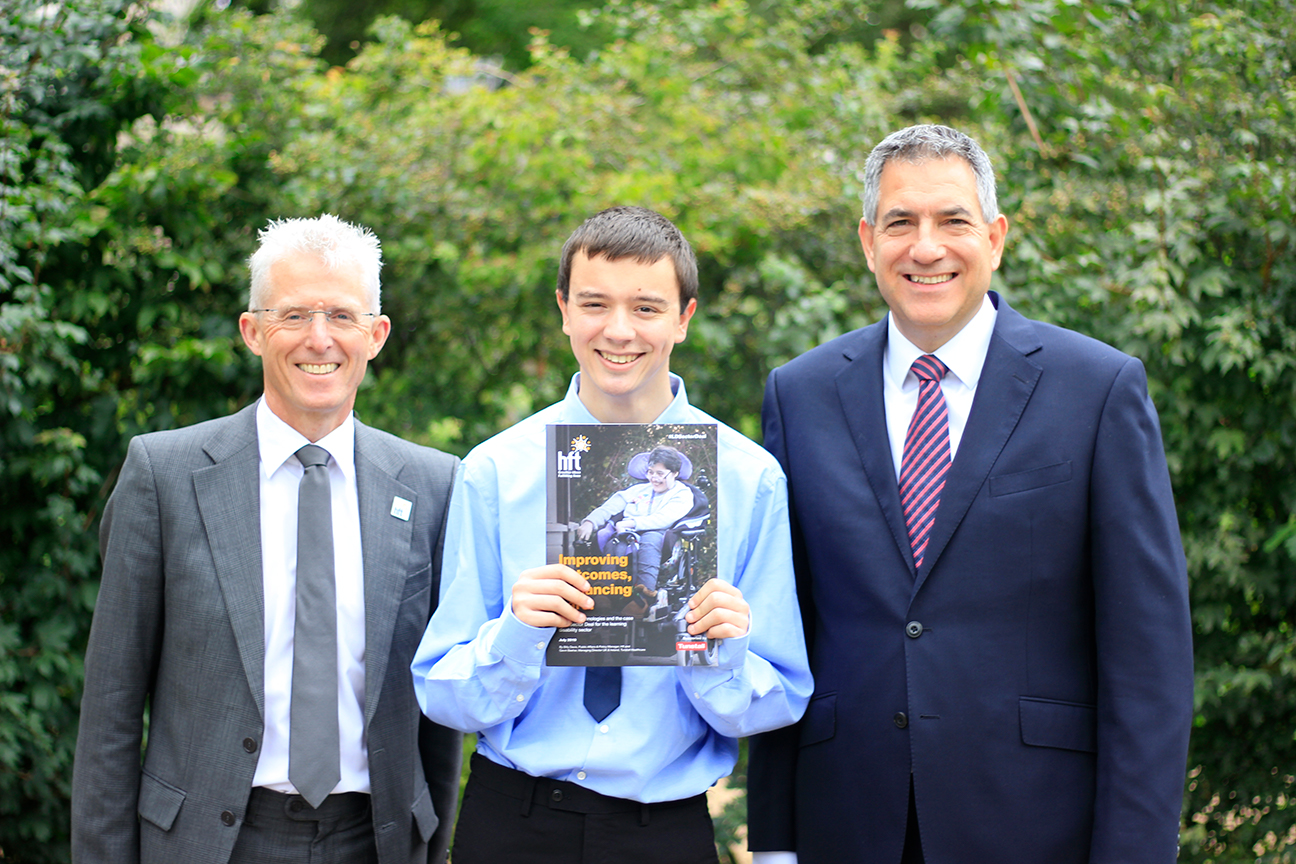 L-R Robert Longley-Cook, William and Gavin Bashar A new report was launched in Parliament last month setting out the case for a deal for the learning disability sector, focusing on realising the potential of technology to boost investment and transform the way care is delivered. National learning disabilities charity, Hft, supported by Tunstall Healthcare, produced the paper outlining the key arguments for an economic partnership with the government as part of the UK Industrial Strategy – a long term plan for the future aimed at backing businesses to drive productivity through investment in skills, industries and infrastructure. The report, which was officially launched at the House of Lords, highlights the challenges faced by a social care sector in financial crisis at a time when demand is growing. Hft and Tunstall believe the successful negotiation of a learning disability sector deal would enable effective investment that could unlock the potential of assistive technologies. In turn, this would stimulate innovation and investment in future services, bring financial sustainability to providers within the sector, and ultimately deliver enhanced outcomes for people with learning disabilities. To mark the launch of the paper, more than 100 guests, including MPs, Peers and civil servants, as well as social care providers and telecare organisations, attended a reception on Monday 15th July in the Cholmondeley Room, hosted by Hft Chair of Trustees and Liberal Democrat Health and Social Care Spokesperson, Baroness Jolly. Hft Chief Executive, Robert Longley-Cook, presented the need for a sector deal, and Managing Director of Tunstall, Gavin Bashar, highlighted the benefits of including technology in services. William, a person supported by Hft, also spoke about the positive difference that assistive technologies have made to the support that he receives.  Technology has allowed William to live independently William, 22, from Bedfordshire shared his personal experience of how technology helped him to achieve his dream of living independently in the community. He uses a key fob to enter his home, which can be deactivated and replaced if lost, and has a lifeline phone and pendant alarm to use to call for help in the event of an emergency. William, who has autism, said: “I feel safe and secure knowing I am only one button away from calling anyone at any time.” The event also marked the official launch of Hft’s new Virtual Smarthouse. The online house showcases examples of assistive technology which different vulnerable groups can use around their home to improve their independence and quality of life, and increase their safety. On the day, attendees were invited to pledge their support for the sector deal and had the opportunity to be involved in shaping what that would look like. Robert Longley-Cook, Hft’s Chief Executive, said investment in the sector is desperately needed. “As it stands, the learning disability sector accounts for around a third of adult social care spend in England and demand is growing rapidly as life expectancy increases. Despite increased demand, local authority expenditure has not kept up, leading to an anticipated funding gap of £5 billion by 2020. “With the funding crisis affecting the sustainability of adult social care, the sector and the government must come together to successfully negotiate a learning disability Sector Deal. “Assistive technology has a key part to play in bridging that gap. Effective investment could transform the way support is delivered to people with learning disabilities and increase their independence, ultimately freeing up staff to focus on more meaningful support. “We believe a Sector Deal will stimulate investment and innovation and ultimately deliver improved outcomes for the people supported by the sector.” Gavin Bashar, UK & Ireland Managing Director of Tunstall Healthcare commented: “We support millions of people around the world, using technology as part of person-centred services to enable independence and freedom. However, not enough people with learning disabilities are currently benefitting from the advantages that assistive technology (also known as telecare) can bring. “Assistive technology can make a positive difference to people with all kinds of disabilities, and in a variety of living environments. As well as managing risks, technology can aid communication, deliver greater privacy and dignity, and give people more control over the way they live their lives. “Tunstall is proud to support the Sector Deal proposal, and its aim of delivering wide-ranging economic benefits and progressing towards a better future for people with learning disabilities in the UK.”
 David Hancock Reporter: Stuart Littleford The healthcare executive advisor at founder-member InterSystems wants the standards organisation to persist with collaboration and focus on adoption David Hancock has been elected to the new role of vendor co-chair at INTEROPen, the collaborative set up to accelerate the development of open standards to enable health and care systems to interoperate with each other. The election of Hancock, healthcare executive advisor at InterSystems, comes at a critical time for INTEROPen, which has grown rapidly from eight founders three years ago to around 350 members today. The organisation has played an important role in shifting the attention of policy makers and informaticians from developing programmes and deploying systems to making sure that they can share information with each other. INTEROpen is now looking at evolving its membership model to support a stronger focus on the take-up and use of standards to support patient care and service transformation. “It is not enough to be able to define standards,” Hancock says. “But to move to the next level, the organisation needs to become vendor-driven, because the best way to make standards stick is to get them incorporated into vendor products. That is why INTEROPen made the decision to create a vendor co-chair and, for me, the role is all about driving adoption.” Don Woodlock, vice president of HealthShare for InterSystems said: “We are proud of our continued association with this important collaboration and we are delighted that David Hancock will be taking it forward for the benefit of the NHS, the health tech community, and everybody who believes in effective, integrated care as the foundation for a system fit for the 21st century.” Hancock has more than twenty years’ experience of working in the health tech industry, having held senior roles at Oracle Corporation and Orion Health before moving to InterSystems in July 2015. He has been a member of the techUK health and social care council for two years and represented the trade body on the INTEROPen board until it decided to create the vendor co-chair position.
Reporter: Stuart Littleford Wiltshire Council has taken a significant step forward by welcoming the first of a team of virtual assistants (VAs) to its workforce. The VA team will complete high volume, repetitive but critical tasks to free up staff time so they can focus on activities that really make a difference to residents and the council. The council is using ground-breaking robotic process automation (RPA) technology; cost effective software that enables manual, rule-based activities across multiple systems to be completed at the most efficient time for our residents and services. The first processes have already been automated, enabling teams to deliver their services in the most efficient and effective way. The payroll team was the first to benefit from this new technology. Automating a time critical and labour-intensive process has given staff the space to focus on where they can add the best value, and has given the council the capacity and confidence to take on more payrolls to support its commercial agenda. Another 10 processes are due to go live in the coming months, with many more in the pipeline. Ian Blair-Pilling, Cabinet Member for IT and Digitalisation, told GPSJ: “This is a really exciting time and we have taken a huge step forward on our digital transformation journey. “Leveraging technology is a key part of our strategy and will shape how we deliver our services in the future, in the most cost-effective and efficient way for Wiltshire residents. “We are an innovative council, and we plan to capitalise on further technological advancements to deliver our business plan. Our staff have been enthusiastic in embracing these opportunities and are excited about the changes it will bring to the way they deliver services.’’ The council is working closely with Thoughtonomy and Microsoft to develop this automation and build in-house staff skills, so they can continue to automate further processes. Phil Sheen, Head of Public Sector at Thoughtonomy, said: “We’re thrilled to be working with Wiltshire Council, its members and staff to deliver the best services possible to residents, businesses and visitors to the county. “Our strategic engagement with the Wiltshire team will see us continue to work closely with them over the coming year to develop their virtual assistant capability. This also provides a new range of digital skills which will be embedded in the council, and continues to demonstrate Wiltshire as a leading innovator in digital public services and citizen outcomes.” This is a key part of Wiltshire Council’s digital programme, which will make it simpler, quicker and easier for residents to access and enable services, while delivering significant savings to the council. For more information please visit: thoughtonomy.com
 Sergeant Kevin Milby A police officer who single-handedly tackled a man stood in the street covered in blood and armed with an axe has had his bravery commended with a prestigious award. Sergeant Kevin Milby was last week named as the North West winner at the 24th national Police Bravery Awards, hosted by the Police Federation of England and Wales. The awards, sponsored by Police Mutual, honour and recognise police officers who perform outstanding acts of bravery. Sergeant Milby received the award for his bravery after responding to reports from numerous members of the public of a man carrying an axe and covered in blood in Dalton in Furness. He confronted the man, Timothy Nickson, urging him to put down the axe but he instead entered a nearby shop. The police officer followed Nickson inside before single-handedly physically restraining and handcuffing him. Further investigation found that Nickson had, shortly before his arrest, forced his way inside an address and attacked a man with the axe, causing life-threatening injuries. The incident took place in June 2017. Nickson was jailed for seven years in November after admitting wounding with intent. Temporary Chief Superintendent Rob O’Connor told GPSJ today: “We are all incredibly proud of Kevin, his decisive actions clearly put the safety of the public above his own. I am so pleased that the Police Federation of England and Wales has recognised his actions with a Police Bravery Award, it is entirely well deserved. “Everyday officers put their lives on the line to protect the public, but this incident went above and beyond on all levels, the man he faced was obviously dangerous, and was in possession of a weapon he clearly had already used. There was no room for error. “During this incident Kevin’s displayed heroic courage and calm professionalism, his actions brought a very volatile and unpredictable incident to a conclusion with no injuries to the wider public. “Kevin is a testament to the Force and I am honoured to serve with him.”
 L-R: Pictured at the Birmingham, Sandwell and Westside Jazz Festival are Cultural Leadership Board chair and Coventry City of Culture chief executive Martin Sutherland, Milda Stasaityte from jazz band The Schwings, Mayor of the West Midlands Andy Street and Remigijus Rancys from The Schwings Local people from all backgrounds and representatives from cultural organisations across the region are being sought to help drive forward the West Midlands’ vibrant culture and creative economy. The West Midlands Combined Authority (WMCA) has opened applications today to join its new Cultural Leadership Board. Residents and cultural organisations will lead the Board with support from topic experts and local authorities. The aim is to link up organisations and residents across the West Midlands to maximise culture’s contribution to this young and diverse region and ensure all groups are empowered to lead, create and participate in cultural activities. The newly appointed chair of the Board is Martin Sutherland, chief executive of Coventry City of Culture. He said: “Culture has the power to bring communities together, stimulate economic growth, challenge accepted ideas and improve everyone’s quality of life. “We are so lucky in the West Midlands to have a rich and diverse cultural sector that brims with talent, entrepreneurialism and creativity. But we also recognise that increased investment and support for the sector is vital to sustain the successes and create new opportunities across the region. “With both the City of Culture and Commonwealth Games on the horizon, we seek to bring together residents and grass-roots organisations, and our region’s major institutions, funders and supporters to create a WMCA Cultural Leadership Board and we are now looking for board members who can help supercharge the cultural economy, to everyone’s benefit. “All those who recognise the role that culture can play in enhancing all our lives – creatives, pioneers, innovators, activists, audiences and investors are encouraged to apply. We look forward to hearing from you.” Cllr Patrick Harley, leader of Dudley Council and WMCA new portfolio lead for Culture and Digital, said: “Cultural activities have many economic and social benefits. These include increasing tourism, improving the perception of local areas, and enhancing community cohesion and wellbeing. “Each year, more than three-quarters of adults in the West Midlands take part in cultural activities, including music, theatre and visual arts. “However, some groups are under-represented, including young people. A key part of the Board’s work will be to identify more opportunities for these groups to get involved. I am delighted that organisations like Beatfreeks and the Positive Youth Foundation are committed to working with the Board and the new Young Combined Authority to achieve this aim.” Amerah Saleh, general manager of Beatfreeks’ youth engagement agency, Young Giant said: “I am excited to know that young people are a priority in making sure that they are around the tables and have an influence on decisions. We are an incredible region because of our wide range of voices, it is a breath of fresh air to know young people are influencing more and more on aspects of life that affect them directly.” Welcoming the launch of the Cultural Leadership Board, Mayor of the West Midlands Andy Street said: “The West Midlands is experiencing a renaissance and we need to make sure that economic development is partnered with diverse cultural offers for residents. “In transport investment, housing developments and when reviving our high streets there is so much that can be done but it needs to be led by the experts and the local community.” The Cultural Leadership Board has been set up to:
Members will be recruited on an open basis from the following two groups:
They will be supported by:
Anyone who would like to join the Cultural Leadership Board should fill in this expression of interest form. The deadline for applications is 30 August 2019.
Web accessibility and language software company Recite Me has created a guide to help public sector bodies including local authorities understand and comply with new public sector web accessibility regulations. The Public Sector Bodies (Websites and Mobile Applications) (No.2) Accessibility Regulations 2018 came into force for UK public sector bodies in September 2018. These regulations set new website and mobile app accessibility standards that public sector bodies including local authorities must follow, although some types of public sector organisations (and specific types of content) are exempt. The regulations implement the EU directive on the accessibility of public sector bodies’ websites and mobile applications into UK law. In order to comply new public sector websites (published on or after the regulations came into force in September 2018) must follow the principles of World Content Accessibility Guidelines (WCAG) 2.1 accessibility Level AA standards by 23 September 2019. Existing websites must follow the principles of the WCAG 2.1 accessibility standards by 23 September 2020. The guide is available now via Recite Me’s website and it gives a summary of the regulations, plus information about what public sector bodies need to do to comply and how Recite Me can help. To make a website or mobile app accessible public sector bodies like local authorities must ensure as many people as possible, including people with disabilities, can use it to do what they need to do. One in five people in the UK have a disability. This number is rising as the UK has an ageing population and most disabilities are acquired with age. So the older we live, the more likely we are to become disabled. But evidence shows that most public sector websites don’t meet accessibility standards. This means they are inaccessible for people with disabilities. For example, a recent study found that only 60% of UK local authority websites’ home pages are accessible to people with disabilities The new regulations are set to change this and the guide by Recite Me will be a useful tool for public sector bodies like local authorities to help them comply with the laws. Recite Me Founder and CEO Ross Linnett said: “All local authorities must take action now to ensure their websites and apps comply with the requirements and deadlines set out in the new public sector accessibility regulations. “The guide Recite Me has created will give local authorities a very clear idea of what the regulations cover and what needs to be done to comply with them, by when. “Although complying with the new regulations may be challenging, having an accessible website that follows the principles of WCAG 2.1 global web accessibility guidelines is a great way for local authorities to reach a wider audience.”
|
 NEED AN UP TO DATE DATABASE? 
 |










Recent Comments